Current Issue

PFAS in surface waters in the Czech Republic

Per- and polyfluorinated compounds (PFAS), a group of fluorinated compounds of anthropogenic origin, have been classified as a persistent organic substances of significant concern due to their chemical properties, widespread use in a number of industrial sectors, environmental spread, long term bioaccumulation potential, and resulting risk to human health. This article brings an overview of current knowledge about the occurrence of PFAS in the environment, mainly in surface, ground, and drinking water and about the methods of their removal from con-taminated water. Furthermore, the legislative requirements regarding PFAS at the level of the EU and Czech Republic are summarised here, including the list of compounds according to the Directive of the European Parliament and the Council 2020/2184 and the Proposal for a Directive of the European Parliament and the Council 2008/105/EC.

From a drop to energy: assessing the hydropower potential of watercourses using results from the “Pico-Hydropower” project

The growing demand for decentralized renewable energy sources has sparked renewed interest in harnessing the hydropower potential of small watercourses. This paper presents a two-stage methodology developed within the Pico-Hydropower project (TA CR, No. TK04030223), aimed at identifying and evaluating suitable locations for micro-hydropower installations in the Czech Republic. The first stage involves a nationwide spatial assessment of theoretical hydro-power potential (HPP) across all fourth-order catchments, based on a combination of digital elevation models (DMR 5G), interpolated values of mean annual flow (Qa), and calculated average channel head (H). The resulting geodatabase enables prioritization of catchments with above-average potential and serves as input for more detailed analyses.

Some aspects of catchment protection upstream of future reservoirs

Protected areas of natural water accumulation have been long monitored and protected. So far, little attention has been paid to the catchment area which will be the future source of water for these water reservoirs from the point of view of influencing their quality. This article focuses on certain diffuse (non-point) processes that may lead to pollution and thus to limited use of accumulated water. It describes the methodology for identifying critical points in the vicinity of the future reservoir, where an excessive amount of sediment loads will enter the aquatic envi-ronment during torrential rainfall events. This will lead to sedimentation of the reservoir as well as to the input of dissolved pollutants. The methodology was applied to all 61 selected sites; the results are clearly presented in Tab. 1 and further discussed. As another non-point aspect, the representation of so-called Nitrate Vulnerable Zones within the reservoir catchment areas is evaluated. Although these areas are assessed in terms of excessive nitrate levels in water, other undesirable compounds used in agriculture may also occur there. As a third aspect, the article describes the status of the land consolidation process in the monitored catchments and discusses their contribution to catchment protection. In conclusion, it is stated that it would be necessary to enshrine into legislation the protection of LAPV catchments, especially for those reservoirs intended for drinking water supply.

The beginnings of timber floating in the region of Novohradské hory

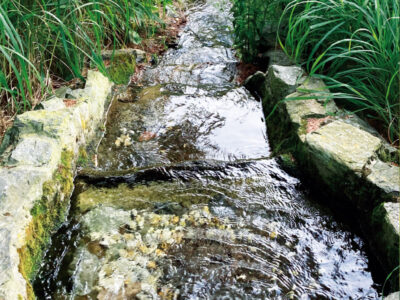
In the last quarter of the 18th century, a unique system for timber floating was built in the region of Nové Hrady. Its creation is linked to the name of the then owner of the Nové Hrady Estate, Johann Nepomuk Buquoy, while the project and its implementation were designed and overseen by engineer Johann Franz Riemer. The uniqueness of the system lay in the fact that it allowed the floating of both loose timber (logs) and bound timber (rafts), even on the narrow and low-capacity streams of the Novohradské hory (Gratzen Mountains). The basis of the navigation system was formed by modified (navigable) watercourses, on which there were reservoirs (ponds) ensuring the necessary amount of water for floating timber. The beginnings of the construction of the navigation system date back to the second half of the 1770s. Materials preserved in the archival records of the Nové Hrady Estate provide insight into the beginnings of the waterway construction in 1780–1784. In 1783, the first part of the construction of the navigation system was completed. From that year on, logs were transported to České Budějovice and the first rafts to Prague. In the section to České Budějovice, the waterway included the Pohořský stream, which con-nects to the Černá and Malše rivers. After 1783, the expansion of the navigation system continued to the upper reaches of the Černá river and its tributaries. The navigation system was completed at the turn of the 18th and 19th centuries by making smaller tributaries of the Černá river navigable and with the construction of reservoirs on those streams. The navigation system was maintained and operated until the first half of the 1940s.

Interview with Mgr. Martin Pták, Director of the Water Protection Department at the Ministry of the Environment

How is Czech water management coping with droughts, floods, and new legislative requirements? Mgr. Martin Pták, Director of the Water Protection Department at the Ministry of the Environment, discusses the Ministry’s current priorities, his professional journey, the challenges facing Czech water management, European legislation, and the need for long-term adaptation to climate change. “Our priorities are clear,” he says. “Adaptation, prevention, and cooperation.”

Jáchymov III: Where does the radon water come from?

Let us return once more – and for the last time – to Jáchymov, a small town nestled in a deep, forested valley of the Ore Mountains. However, Jáchymov boasts many other remarkable firsts and renowned “bests”. It was here that the world’s first radon spa was founded, centred around the construction of the grand Radium Kurhaus (author’s note: today’s Radium Palace) – once one of the most luxurious hotels in Europe (Fig. 3). The origins of the spa are closely tied to the discoveries of Marie Curie, the first woman to earn a doctorate from the Sorbonne and to receive two Nobel Prizes. In 1520, Jáchymov also became home to the first pharmacy in Bohemia. To this day, the town remains unique worldwide for its use of brachytherapy (“Jáchymov boxes”, BRT), a specialized treatment method found nowhere else. All these remarkable Jáchymov milestones have already been discussed in detail in the April and especially August issues of VTEI this year. So now, let us turn our attention to another local marvel that literally shaped Jáchymov’s history – Svornost Mine. And let us start from the very beginning.