List of articles from – 1/2026

Food waste from the perspective of municipalities – approaches and measures for reducing production and preventing its occurrence

The presented article addresses current problems in food waste management and prevention at the municipal level in the Czech Republic. It summarises the authors’ team’s knowledge within the framework of long-term solutions to this issue, presents a diverse range of preventive measures, conducts an elementary economic analysis of municipal expenditures and revenues in waste management, and points out current problems and pitfalls for development in the coming years. The most important ones include the growing obligations of municipalities in preventing the creation and management of municipal waste and the associated increasing pressure on staffing the circular economy and waste management agenda, insufficient capacities for food waste management in the near future (with the planned fulfilment of national goals), an inadequate system of transmission and exchange of relevant information, and the ever-recurring indiscipline of citizens in primary waste sorting.


Current approaches to determining flood hazard in river confluence areas

The study focuses on assessing changes in runoff conditions and approaches to determining flood hazard in confluence areas of river systems. Based on the analysis of several model catchments, the results of numerical simulations of water flow during floods with different return peri-ods are presented. The analyses revealed that separate modelling of the main river and its tributaries produces distorted results, as the hydraulic conditions in confluence areas are characterized by complex interactions between individual streams. Therefore, the authors recommend a comprehensive approach using 2D numerical models, which allow for more accurate evaluation of inundation extent, water depths, and flow velocities. The study results include proposals for updating the methodological guidelines of the Ministry of the Environment, emphasizing a unified approach to the development of flood hazard and risk maps.

Atmospheric deposition of polycyclic aromatic hydrocarbons in the pilot catchment area of Výrovka and urban areas of Prague and Ostrava

Atmospheric deposition is the most significant source of polycyclic aromatic hydrocarbons (PAHs) in surface waters in the Czech Republic. These substances originate predominantly from combustion processes. Through deposition, PAHs reach the Earth’s surface and are subsequently washed into surface waters. Although the state and the private sector have implemented a number of measures in recent decades to reduce emissions, not only from major pollution sources but also from households (local heating), these substances continue to have a significant impact on the aquatic environment. Selected PAHs are included on the list of priority substances due to their proven adverse effects on aquatic organisms and human health, and strict environmental quality standards have been set for them in surface water and biota matrices. Con-sequently, most surface water bodies do not achieve good chemical status according to the Water Framework Directive 2000/60/EC. Research in the Výrovka river basin (a tributary of the Elbe river) comprehensively addressed PAH contamination in relevant matrices of the aquatic environment and in Schreber’s big stem red moss (Pleurozium schreberi), which is a suitable indicator of air pollution. At the same time, PAH fluxes in wet deposition in selected urban locations were monitored for comparison. The origin of PAHs was assessed using fingerprinting, based on the analysis of ratios between individual PAHs in the monitored matrices, enabling the distinction between petrogenic and pyrogenic sources.

Environmental objectives and aquatic environment limits for stone crayfish

The stone crayfish (Austropotamobius torrentium) is a critically endangered species listed on the Red List of Invertebrates of the Czech Repub-lic. It is protected under Decree No. 395/1992 Coll. and designated as a priority species according to Council Directive 92/43/EEC on the conservation of natural habitats, wild fauna, and flora. It is generally assumed that stone crayfish requires water quality that meets at least the emission limits for salmonid waters as defined by Government Regulation No. 71/2003 Coll., as amended, and also by Government Regula-tion No. 401/2015 Coll., as amended. Stable and abundant populations, however, require stricter environmental objectives, both in terms of limit values and the range of monitored parameters. To establish these objectives, 14 sites were selected. These sites are either unaffected or only slightly influenced by human activities, with confirmed current occurrence of stone crayfish or historical presence where disappearance was probably due to crayfish plague.

Application of thermometry in the exploration of mineral springs – Mariánské Lázně and Karlovy Vary

Thermometry is a non-invasive technique suitable for detecting hidden mineral water springs. Its applicability was evaluated in two contrasting hydrogeological settings: Mariánské Lázně, characterized by cold, CO₂-rich mineral springs, and Karlovy Vary, dominated by thermal springs.

Interview with Assoc. Prof. Ing. David Stránský, Ph.D., Head of the Department of Municipal Water Management, Faculty of Civil Engineering, CTU in Prague

Six years ago, Assoc. Prof. David Stránský spoke in the Priorita journal about the fact that by linking rainwater with urban greenery, a city can obtain a form of cheap air conditioning. Since then, the topic of water management in cities has advanced not only in terms of legislation and technologies, but also in the approach of the public and local authorities. How does he view developments in this field today, where is research at the Department of Municipal Water Management at CTU heading, and what does he consider to be the key to a sustainable ur-ban environment? These were the questions we addressed in the following interview.

Water management in the Czech Republic in the context of climate change – expert findings from the 5th Water Centre conference

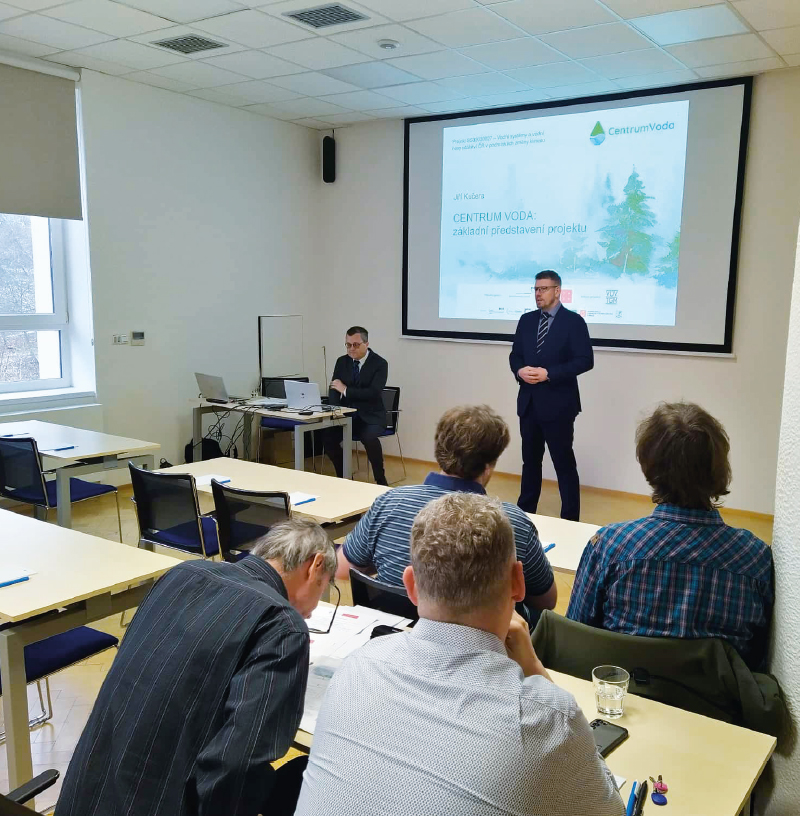
The Fifth Water Centre conference, held on 25 November 2025 at TGM WRI, focused on water management in the Czech Republic under con-ditions of ongoing climate change. The event, organised with the support of the Ministry of the Environment and the Technology Agency of the Czech Republic, presented current research results in the fields of water resources modelling, landscape water retention, water quality, and adaptation to extreme weather events. The conference followed on from previous years, which have long provided a platform for the presentation of research outcomes in water management and for fostering interdisciplinary dialogue between experts from both the academic and applied spheres. It also confirmed the growing importance of interdisciplinary cooperation in addressing environmental challenges and presented a number of practically applicable insights for water management practice.