

He regularly contributes both scientific and informative articles to VTEI, reviews other submissions, and for two years had his own column on the back cover. He loves nature and animals and is an accomplished photographer. When he first contacted me in spring 2023 to offer a scientific article, which was published that summer, he sent me a photograph for his author profile that was strikingly different from the usual ones: a man in camouflage, kneeling on the ground in a forest, surrounded by his three enormous dogs. “Nature is still the stronger player,” says Assoc. Prof. RNDr. Jan Unucka, Ph.D., who is now sitting across the table from me.
Associate Professor, do you still remember that photograph?
Of course I do (he looks up at my noticeboard, where the photograph in question has been hanging for the past three years).
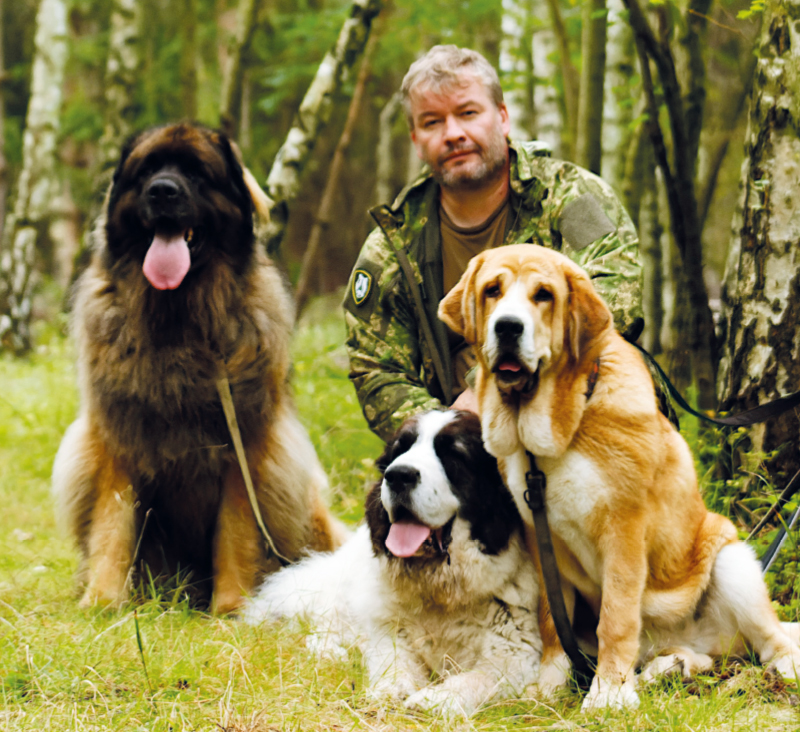
Fig. 1. Assoc. Prof. RNDr. Jan Unucka, Ph.D., with his dogs – from left: Leonberger, Pyrenean Mastiff, Spanish Mastiff
I must admit, even then I had an idea about how I might get that photograph into VTEI. It was obvious that we weren’t going to squeeze it into a scientific article, and certainly not into an author profile, so I decided that one day I would simply have to interview you… So, welcome to Prague.
(Laughs.) Thank you for inviting me.
I also really liked something you wrote to me right at the beginning of our correspondence in May 2023: “Above all, don’t call me Associate Professor!” May I ask how someone manages, almost “in passing”, to acquire four university degrees and yet describes himself as a labourer? Isn’t that being just a little too modest?
I don’t think so, and I hope it doesn’t come across as false modesty either. If I go right back to the beginning, I was fascinated by nature from childhood, and I also loved trains. So as a boy I never went through the usual astronaut–firefighter–policeman–soldier phases. For me it was always quite clearly either train driver or naturalist. What’s more, while I was studying, I actually earned money doing various manual jobs – laying paving, bricklaying, carpentry, and working at a sawmill. Even now I occasionally help out with some carpentry or drive a lorry for a friend. It’s a form of relaxation for me, although I don’t have much time for it these days. But I have a great deal of respect for manual work, especially skilled manual work.
So what ultimately decided it?
I still love trains; I enjoy travelling by train, and I have plenty of friends who are train drivers, but in the end, becoming a naturalist won out. Perhaps that was partly because there were far more books about nature, and I was always an avid reader. At home, I tried to read as many books as I could, and my parents and grandparents often bought them for me too. At the same time, though, my father worked at the Czech Hydrometeorological Institute (CHMI) in Ostrava as a surface-water technician, so I had no ambition to go into hydrology because I didn’t want to follow in his footsteps. And that brings me back to the idea of being a manual worker – I deliberately chose to attend a secondary technical school specialising in electrical engineering and computer technology, quite simply so that I wouldn’t have to go to a grammar school and then on to university.
That certainly sounds like someone with two doctorates and a habilitation. :-)
(Laughs.) Well, that’s how it turned out in the end anyway – I completed my Master’s degree, followed by my first and then my higher doctorate. By that time, I was already teaching natural sciences at the University of Ostrava and at the Faculty of Mining and Geology at VSB – Technical University of Ostrava. Without it ever featuring in any kind of “personal development plan”, it eventually led to my habilitation and appointment as Associate Professor at VSB – Technical University of Ostrava, with a focus on the use of geographic information systems and mathematical models in environmental sciences.
How long did you teach?
If I remember correctly, I started straight after my first state examination, in 2003. At the Faculty of Science, I taught hydrology and landscape science, while at the Faculty of Mining and Geology I taught practical classes under Associate Professor Grmela, historically one of the leading hydrogeologists in the country and, moreover, someone with extensive practical experience. So it was a tremendous learning experience for me too, and you could say that I learnt by teaching.
My regular, timetabled teaching at both faculties continued until around 2019. In the meantime, however, I joined the CHMI in 2014 and gradually began cutting back on my teaching – I mostly taught while on leave or after work well into the evening. Eventually, I realised that you simply can’t do everything, and I quietly drifted away from university life.
Don’t you miss having students and young people around you now?
I’m fortunate enough to have them on my team. We have quite a few recent graduates working with us, so I don’t miss that “breath of fresh air”, as they say. I also still teach occasional intensive blocks at the Mathematical Institute of the Silesian University and at the Faculty of Science of Palacký University, so I’m still in contact with students. But I should stress that I only teach in blocks, always on a specific topic, so that I can keep up with all the operational and development work associated with the CHMI, because that is now my priority.
Your work also occasionally takes you to the Faculty of Science in Prague. May I ask why, after your studies, your career took you to Ostrava in particular?
Although I’ve lived near Opava for years now, I was born in Ostrava. And since my studies weren’t really planned or heading in any particular direction at first, I simply took the opportunities that came my way. At the time, Professor Kříž was working in the Geography Department at the University of Ostrava. He had been the first director of the CHMI’s Ostrava branch and could, in a sense, be regarded as its founder. He had been my father’s boss, and for a while my mother’s too, so those connections eventually led me to study physical geography at the Faculty of Science there.
I know you have a farm. So did you choose to live in the countryside?
Yes, I live in a village not far from Opava. I’m not really a city person; I like being close to nature. Even as a boy, I loved going off on hiking trips into the woods. It was my main hobby, and one that combined nicely with travelling by train along local railway lines, many of which have since been abandoned. I’m still drawn to nature today. That’s why I wanted to live somewhere outside the city, where I could be close to nature but still within a reasonable drive of work.
Could that desire to head into the woods, take the dogs and get out into nature be a kind of escape from a reality that isn’t always entirely positive, particularly when it comes to climate change and projections for the future?
Definitely. It unquestionably gives me a sense of peace. When my wife and I take the dogs into the woods, we often hear people commenting on how miserable the weather is or that it’s raining and we still have to go out. And I would add: yes, we have to, but we also want to. What’s more, the gloomier and less appealing the weather, the fewer people there are in the woods and the better the chances of seeing more wildlife, so it clears your head all the more. Above all, though, there’s something refreshing about being with dogs, which are always completely absorbed in the present moment, whatever the circumstances and whatever the time of day or night. For me, it’s the best form of relaxation I know – both mentally and physically.
I know you’re also a keen nature photographer. After all, you regularly send me a steady supply of wonderful photographs for VTEI, for which I’d like to thank you once again. How did you first get into photography?
I got my first digital single-lens reflex camera around 2016. Before that I had a Panasonic Lumix, which even today is capable of taking perfectly decent photographs for amateurs and semi-professionals. At first, I went through a phase when I wanted to document absolutely everything, to understand nature and get to the bottom of it all, but I’ve given up on that now. Nature is such a complex, multilayered system that this is essentially a futile ambition. It is enough to begin to recognise and understand the connections within it, so that you can do your own work better or pass on new knowledge to your students, professional colleagues, or the wider scientific community.
At first, you have such an appetite for photographs that if you come back from the woods or the river without a perfect shot, you feel the day has been wasted. Fortunately, that phase didn’t last long for me. After that, my own ethical principle took precedence: if taking a photograph might endanger a clutch of eggs or young animals, for example, or even cause an animal to abandon them or result in injury, then no photograph is worth it. These days, I quite often find myself putting the camera aside and simply trying to enjoy the moment.
Did you first get into photography through Kozmice Bird Meadows, where you also help with maintenance and feeding?
Exactly. Kozmice was where I first started taking photographs to specific briefs, focusing on particular animal species or on the wild horses there. The horses are particularly difficult to handle, and it is often very difficult to get close enough to photograph specific identifying marks, their colouring and so on. But that makes the results all the more valuable, and I particularly treasure the photographs that have turned out well.
Who introduced you to Kozmice Bird Meadows?
It happened entirely by chance, which brings me to my belief that all the important things in life happen by chance. We were there walking the dogs, as it isn’t very far from where I live, and the site manager, Petr Bláha, who has since become a very good friend, spontaneously struck up a conversation with me about dogs, nature and so on, and we discovered that we had a great deal in common. I told him that I was particularly interested in Kozmice from a hydrological perspective, because the CHMI has a monitoring well nearby. Since then, our conversations and shared views on nature have developed into a strong friendship, and whenever I can, I enjoy helping Petr with the wild horses, as well as with the Highland cattle that now live there.
How do these wild animals cope outdoors with the heatwaves we experience nowadays? And which is actually worse for them – heat and drought, or freezing conditions when everything is covered in snow and they don’t have enough food?
Definitely drought and heat. To a large extent, Kozmice Bird Meadows can be seen as a kind of laboratory, because a whole range of habitats and ecosystems are developing across its 71 ha. It is essentially a former fishpond landscape that was subsequently used for agriculture and has now been returned to nature, although succession has not yet reached a state of equilibrium everywhere. Water management is the top priority there because not only various species of waterbirds, such as waders, but also the wild horses and Highland cattle depend on it. Quite simply, we cannot do without water, so dry years and periods of hot weather aren’t good for them either.
Another issue is open grassland versus forest. It is very clear there that, in hot weather, not only the birds but also all the ungulates, including the roe deer that live there, actively seek out shade and areas with higher moisture levels. So the traditional and much-valued mosaic character of the Czech landscape remains an ideal model for today’s cultural landscape for wild animals that are able to move freely in search of water.
By contrast, the winter conditions you also asked about do not pose a serious threat to them. The main problem is freezing rain and ice, when they are unable to reach the vegetation beneath it.
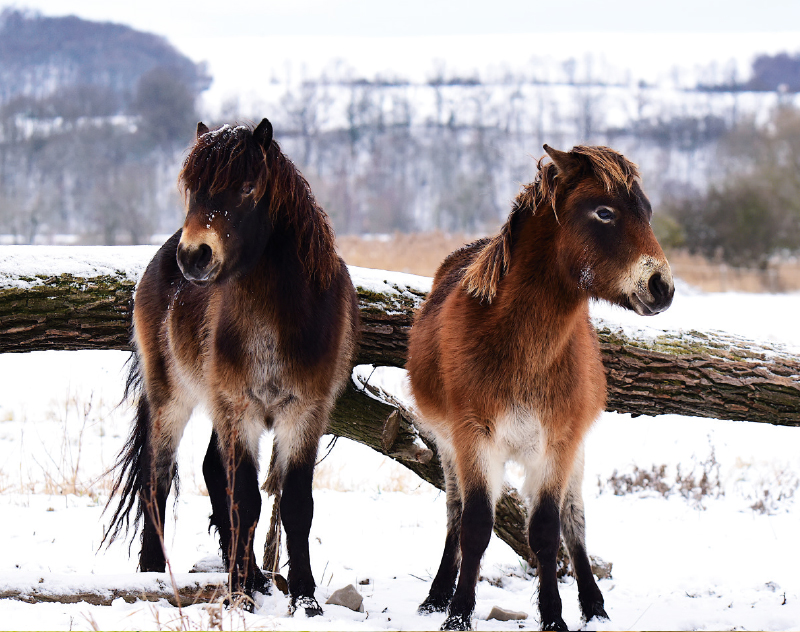
Fig. 2. Exmoor pony in winter, Kozmice Bird Meadows
There have recently been reports in the media suggesting that some parts of the Czech Republic, such as South Moravia and Polabí, are already experiencing conditions more typical of a subtropical climate zone, with hot summers being compared to the climate of Mediterranean islands such as Hvar. What might this mean for us in the future? Is this trend expected to worsen, and according to CHMI projections, will temperatures continue to rise?
As you know, CHMI and your T. G. Masaryk Water Research Institute both collaborated on the PERUN Competence Centre, where global scenarios were tested and downscaled for Central Europe and the Czech Republic. There are also various other scenarios that start with socioeconomic factors, technology and population growth, which in turn determine emission levels and so on. I think it is clear even from the official conclusions presented, for example, by my colleague Radim Tolasz, that we are not in for an idyllic time in the years ahead. If one of the intermediate scenarios comes to pass, rather than the worst-case one, we can count ourselves relatively fortunate.
If I put the computer simulations to one side and look at it simply by taking a walk through the landscape, the aridification is obvious. Not only are xerothermic communities expanding, but every gardener today knows that if you cut the grass too short, the lawn gets scorched and, without watering, nothing green is going to grow there, let alone flowers or herbs. And if I look at it from my professional perspective as a hydrologist, two things are clear. The first is that extremes are increasing. You could say that total annual precipitation has not changed dramatically, but the types of precipitation and their distribution throughout the year are changing. Winter precipitation is decreasing, markedly so at middle and lower elevations, which means that the Oder-type flooding once used as a textbook example, where spring snowmelt causes spring floods, has now virtually disappeared. The second is that the frequency of thunderstorms and convective precipitation is increasing at the same time. Rain falls on the landscape and often runs off outside the watercourses; infiltration and percolation effectively do not take place. As a result, it may take only a few hours, or a few days at most, to go from a devastating flood to drought. To give you an example from the practical experience of field technicians: when my father and his colleagues used to measure some of these river profiles, they naturally had to take their measurements from a bridge, whereas today we can walk across them in wellington boots. Flows have been declining over the long term.
In this context, what impact do the views of those who criticise or reject climate change have, particularly when they are given a platform in the media? How do experts such as yourself view this?
To be honest, I have always tried to keep politics out of both my private and professional life. What’s more, things taken out of context can be extremely dangerous. In any case, whatever has been said on this subject, and however it was intended, it is not particularly helpful. This is precisely where the fundamental problem lies. Experts generally acknowledge a certain degree of uncertainty in all data, scenarios and projections. To the casual observer – someone sitting in a pub watching television, for example – that can make an expert look like a bit of a “fool” who doesn’t really know what they are talking about. By contrast, categorical political pronouncements, delivered with confidence and certainty, reinforce the impression that the person making them knows exactly what is what. To me, that is probably the most dangerous aspect of debates like these. I believe that people in all professions, politicians included, should recognise that we share a common goal: the sensible functioning of civilisation and the survival of Homo sapiens on this planet. Personal passions or attempts at self-promotion should take second place to that.
Two years ago, you and your colleagues measured discharges and carried out geodetic surveys of the high-water marks left by the September 2024 floods in the Jeseník area. Looking back, what has changed most in this field compared with the past? In other words, what are we now able to measure, what conclusions can we draw from these measurements, and how do mathematical models help us?
In this context, I’m reminded of a saying which I think also appeared in one of Václav Cílek’s books: “In times of drought, think of floods, and vice versa.” In other words, drought and floods are the two hydrological extremes, but they are essentially two sides of the same coin, interconnected phenomena.
I think new technologies are helping us enormously, both to speed up and improve the quality of primary data collection in the field, including measurements taken during floods. This is also limited by whether we can actually reach a particular river and whether we can take the measurements without putting the health and lives of field staff at risk. Sometimes that is the most difficult part. And I’m not even talking about individual gauging stations or monitoring profiles – some stations in the area covered by our branch literally disappeared from the map of the Czech Republic during those floods.
If I compare today’s measurements using sonar, which can process acoustic data, with the current meters that used to be lowered from a bridge on a suspension cable, we are now in a completely different league, both qualitatively and quantitatively. Sonar has its limitations too, but under good conditions it can immediately plot the cross-section and velocity field and calculate the discharge, so if local mayors have any questions, we already have the information to hand there and then, on the riverbank or bridge. A second major benefit is the ability to process and convert the data digitally using mathematical models and geographic information systems.
The flood report produced at the time, which is available for download from the Ministry of the Environment website, shows, among other things, that without the aid of mathematical models it would have been impossible to determine the magnitude of the flood at some river profiles and along some reaches. Hydrology textbooks generally give flow velocities during natural floods of between four and four and a half metres per second; my colleagues and I routinely measured six metres per second.
After the horrors of 2024, is it possible to find anything positive in what happened – perhaps lessons for the future?
I always try to find something positive. For example, we have begun making much greater use of remote sensing data, which, together with our field measurements, have been used to calibrate hydraulic models for evaluating peak discharges and the extent of flooding. If I compare this with the last similarly catastrophic flood in Moravia and Silesia, in 1997, these technologies were still in their infancy and adequate data were not available either. Nevertheless, nature is still the stronger player in this game we are playing.
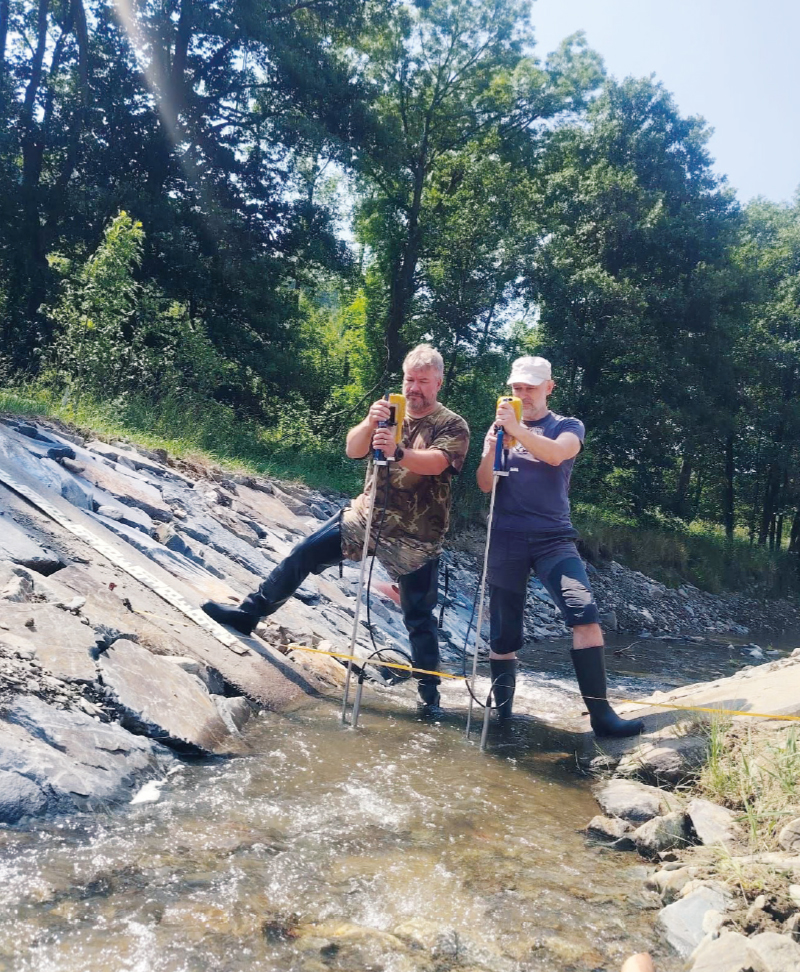
Fig. 3. Taking measurements on Kobylí stream near Karlovice with former fellow student and colleague Dr Martin Adamec
Do you ever worry that current trends towards rejecting or denying climate change could lead to real dangers, for example by underestimating the severity of a flood and the risks it poses?
Of course. Unfortunately, that is something I have experienced myself. Before the 2024 floods, the hydrological and meteorological models were in very close agreement, so there was growing confidence that a truly catastrophic flood was approaching, with a magnitude and characteristics comparable to the 1997 flood. Despite this, I heard a dismissive response from around 30–40% of people: “Surely something like that can’t happen again.” I found that utterly incomprehensible. After the floods, I spoke to firefighters and officers from the Police of the Czech Republic, who described how they had had to rescue by helicopter people who had refused to leave their homes when the evacuation order was issued, plucking them from trees and rooftops. It had been a matter of seconds and quite literally a matter of life and death. It was a deeply disturbing thing to hear. So I would once again urge everyone never to take the risks indicated by flood forecasts lightly. What’s more, I would venture to say that flood extremes are more likely to increase than decrease.
Obr. 3. Se spolužákem a kolegou Dr. Martinem Adamcem při měření na Kobylím potoce u Karlovic
Would you say that public awareness has improved since the floods of 1997 and 2002? Do models also help you with forecasting?
Definitely. The systems are more sophisticated and, above all, warning information is now distributed much more quickly and effectively. I understand that there can sometimes be too much information for the general public and that non-specialists can occasionally become lost in all the communication noise. In any case, in terms of the availability of information, the speed of calculations and the production of forecasts – whether rainfall-runoff models used to estimate peak discharges or meteorological models used to determine where the heaviest concentration of rainfall will occur – we are at the technological forefront, and anyone has the opportunity to access this information.
Let me now touch on a favourite Czech topic: would dams and large reservoirs help in our situation?
I’ll start by taking a slightly broader view. The fundamental point, as I see it, is that we live in a cultural landscape. This means that, whether we like it or not, apart from the occasional hiking trip or holiday, we are accustomed to enjoying the benefits of modern technology. Manufacturing cars, computers or mobile phones obviously consumes water, while our everyday needs in terms of food and hygiene also entail a certain level of water consumption, whether we live in a town or in the countryside. So when someone calls categorically for the removal of technical flood-protection or water-management measures and advocates a return to nature, I think that is simply no longer achievable. What I mean is that nowadays we cannot do without reservoirs, whether for flood protection, energy generation, supplying water to households and industry, or other purposes. The demand for water and for a certain level of comfort is considerable.
In any case, if reservoirs are going to be built, they should be designed to be as efficient as possible, both in terms of their design and capacity and their operating parameters – in other words, what their priorities are. For example, whether their primary function is power generation, as at Dlouhé Stráně, or whether they are multipurpose hydraulic structures that provide water supplies as well as flood protection.
When Professor Pavel Pech from the Faculty of Environmental Sciences at the Czech University of Life Sciences Prague was sitting in this chair about three years ago, one of the things I asked him about was the construction of large reservoirs and dams in the Czech Republic, including Nové Heřminovy, and why – to put it in layman’s terms – everything takes such an incredibly long time here. Apparently, the Nové Heřminovy dam was first planned after the floods of 1997.
It is certainly a protracted process, partly because governments keep changing in this country, and with them their priorities and stated objectives. But if I may, I’d like to correct you on one point – although there was really no way you could have known this. Do you remember when we were putting together our team’s article reconstructing the historic 1903 flood in the Opava catchment…
… Of course, that was only recently (the paper by Associate Professor Unucka et al. was published in VTEI in June this year; author’s note).
… Well, while working on it, I began collaborating closely with Dr Irena Moravcová from the Silesian Museum in Opava, and we discovered that the first proposals to build a dam at Nové Heřminovy actually date from around that time.
So in reality, it has already been more than 120 years?
Yes (laughs). After the catastrophic flood of 1903, a joint Prussian and Austro-Hungarian commission identified a site in the Opava valley as suitable for the construction of a hydraulic structure. Cross-sections and a longitudinal profile were surveyed, and initial proposals were even made for the basic parameters of the dam itself. So the 1997 flood really only revived an idea that had been forgotten in the meantime.
Another important aspect from my perspective is how the issue is presented. Every flood-protection measure has its limitations, whether it is biotechnical and nature-based or a conventional water-management measure. And it is only fair to acknowledge that every hydraulic structure has a finite capacity and an initial water level. It is precisely this limitation on storage capacity that has been the main sticking point in the protracted debate between supporters and opponents of the dam.
Let’s return to the other extreme, drought. Is there a real risk that we could face water shortages – or, more specifically, a shortage of drinking water for the population as a whole?
I think it has already happened several times. Indeed, that is one of the reasons why regional Drought Management Plans were drawn up at national level. However, their implementation in practice is still in its infancy, and local and regional authorities do not yet have sufficient practical experience of implementing them. Nevertheless, the plans do exist and are available to the regional authorities. In my view, nature has so far been fairly kind to us here in Central Europe, and we have not yet reached an extreme where the most stringent measures would have had to be introduced. But some restrictions were already in place here between 2017 and 2019.
Of course, looking at the rest of the world, it would be foolish to dismiss the possibility of drinking-water shortages on the grounds that the problem does not concern us. Water and drinking are physiological necessities, and we cannot survive without them. After all, history has been showing us since ancient times that shortages of water and food can even lead to the collapse of civilisations.
Speaking of history, you’ve just given me a lead-in to my next question. Could we say that if a meteorologist, a hydrologist and, for example, a historian from an archive were sitting around the same table, they would have plenty to talk about and would find some common ground in their work? You also mentioned the police and firefighters in connection with floods, so is it really about all these people working together?
Definitely. There is a willingness to work together, and we even have friendly ties and relationships with one another, so the collaboration works very well. In fact, that is what I like most about hydrology – it lies at the interface between the natural and engineering sciences, while historical floods also give it a connection with the social sciences and history, offering a rather romantic glimpse of the landscapes of Bohemia, Moravia, and Silesia in the past.
And we then put that into practice. For example, CHMI regularly takes part in the Water Mills event organised by the Ústí nad Orlicí Museum and its director, Dr Radim Urbánek. Several times during our presentations there, I’ve asked Radim whether our participation in the event isn’t becoming a little stale, but his response is always that we bring a different perspective that historians don’t have. And conversely, to return to Dr Moravcová, I would have been completely overwhelmed in the archive by piles of files on the table and, without her insight, I wouldn’t have had the slightest idea where to begin or what to photocopy first. They have thoroughly mastered their own craft, and it is precisely this interaction with us natural scientists and hydrologists that creates added value: on the one hand, the historical experience and knowledge of the landscape of our ancestors, to use a familiar phrase, and on the other, lessons for the present – for example, how we can manage water in today’s landscape more effectively. I don’t think hydrologists alone could piece all that together without historians and archivists.
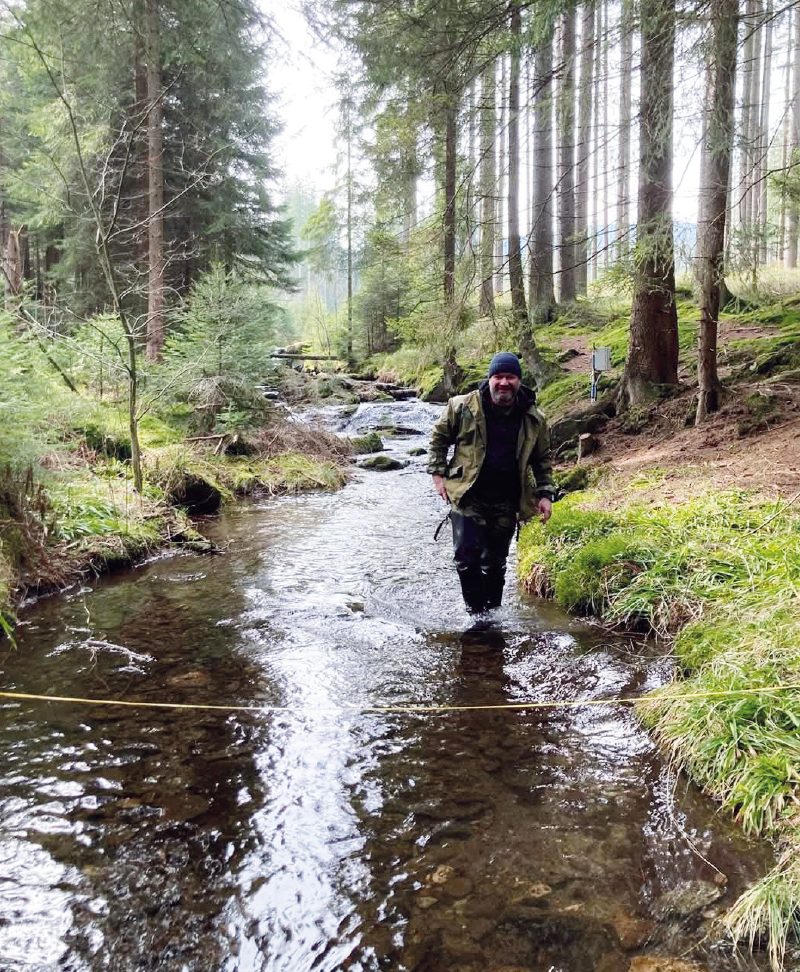
Fig. 4. Taking measurements in Slučí stream experimental catchment below Rejvíz, operated by the Forestry and Game Management Research Institute and CHMI
Do you have a favourite place? Given how often your work takes you out into the field, I’m sure there must be quite a few in Bohemia, Moravia, and Silesia…
People probably expect a hydrologist to say…
“I love water…”
Exactly (laughs). I really do love rivers, and I try to spend time by them in my private life too, when I can put my professional work to one side and simply appreciate them as beautiful places. I have three favourite catchments in the Czech Republic. One is definitely the Křinice in Bohemian Switzerland, another is the Březná around Štíty and Hoštejn – for me, the Březná valley is one of the most beautiful I know – and then there is the Černá Opava, or more broadly the Opava catchment and its tributaries, around Rejvíz and the boundary between the Hrubý Jeseník and Nízký Jeseník mountains.
And speaking purely for myself, one of my favourite places is Jakartovice, where I used to go hiking even as a boy. It is a wonderfully romantic landscape of former slate mines and flooded mine workings, a place that holds many memories for me, and it is also fascinating in terms of its wildlife. The Eurasian eagle-owl, for example, is quite common there, although it is otherwise almost absent from the Nízký Jeseník, as is our smallest owl, the Eurasian pygmy owl, which I have even managed to photograph a few times. Fortunately, it isn’t particularly shy – rather cheeky, in fact. :-) These are the places closest to my heart, the ones I’m always happy to return to.
Does your work leave you enough time for that?
Sometimes more, sometimes less. Unfortunately, mostly less. But whenever I can, I try to spend all my free time in nature. I have to admit that, despite being from Ostrava, I’ve never even been to the Karolina shopping centre.
I understand. So it’s more about escaping into the woods and spending time with your dogs…
Yes. Animals are always a reminder to me that, in our arrogance, we humans still tend to think of ourselves as the masters of creation, simply because animals do not possess articulate speech. But that does not mean they cannot do some things better than we can. Often it is a matter of subtle vibrations that lie beyond the limits of human perception. I know that certain types of dogs, cats and birds, as well as other animals I have had the opportunity to get to know better, are far more attuned to these things than humans are.
What I love most about dogs in general is their straightforwardness and the way they express their emotions so openly. We should enjoy moments like that more and appreciate every day we have with them. After moving to the countryside, I ended up – again, entirely by chance – breeding livestock guardian dogs. I always say that I didn’t teach them; they taught me, because they are a completely different type of dog. You cannot drill them into obedience – with them, it really is all about partnership. And that makes the relationship all the more rewarding and, for me, all the more beautiful.
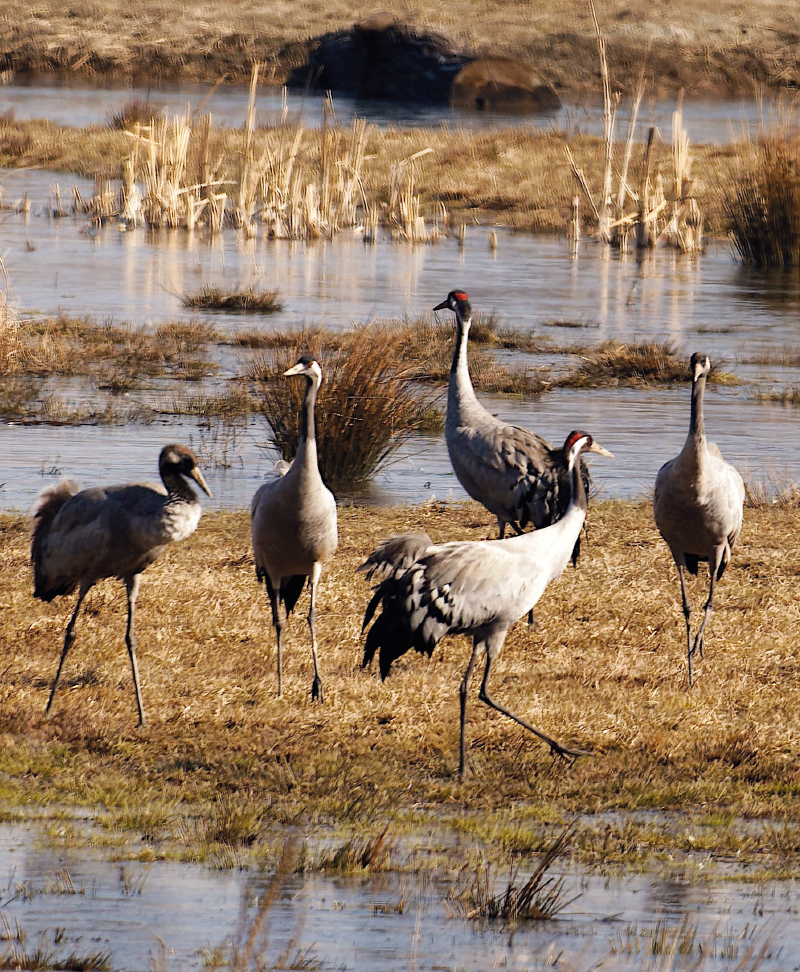
Fig. 5. Common crane after arriving at Kozmice Bird Meadows
Associate Professor, I wish you not only good health and every success in your work, but also many wonderful moments in nature with your canine companions. Thank you for taking the time to travel to Prague and give me this interview for VTEI. I would also like to thank you once again for all your photographs of nature and for our excellent collaboration, which I hope will continue for many years to come.
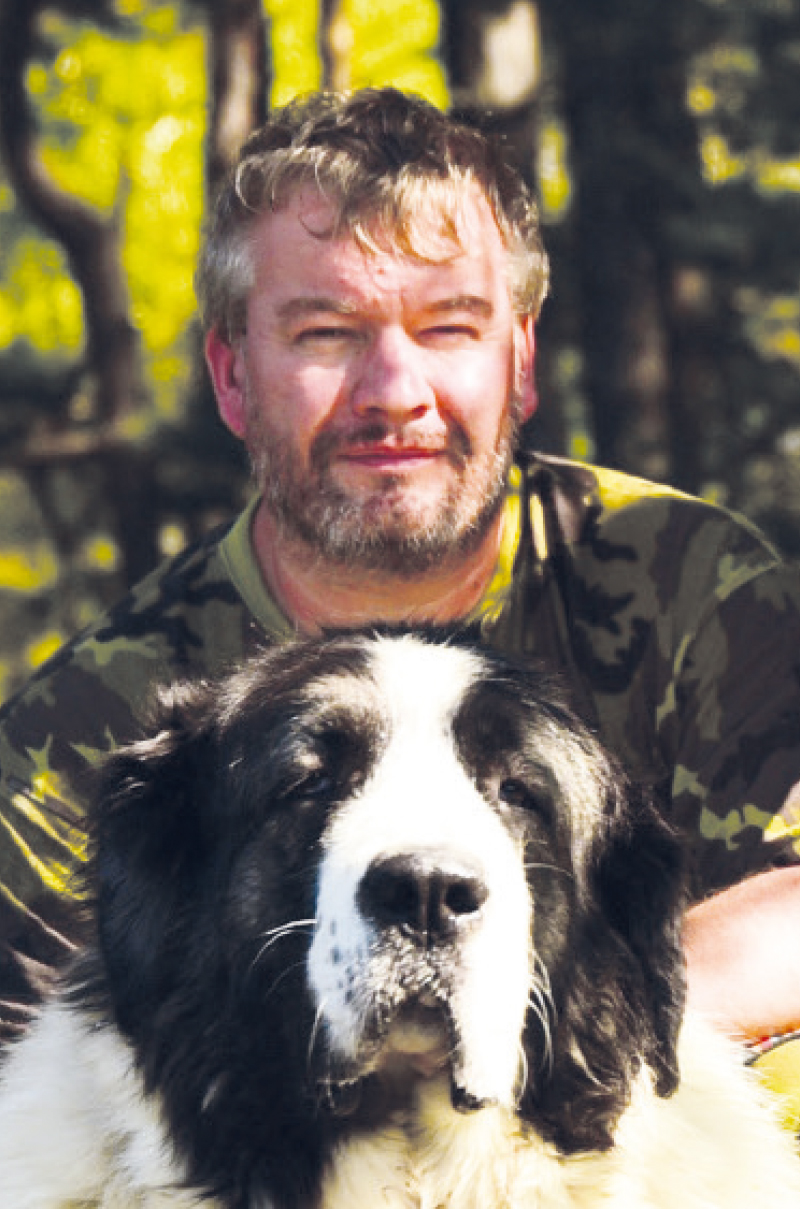
Assoc. Prof. RNDr. Jan Unucka, Ph.D.
Assoc. Prof. RNDr. Jan Unucka, Ph.D., was born in Ostrava on 20 January 1977. After completing secondary school studies in electrical engineering and computer science, he studied Physical Geography and Geoecology and Environmental Geography at the Faculty of Science, University of Ostrava, first at master’s and subsequently at doctoral level. He then completed his habilitation in Geoinformatics at VSB – Technical University of Ostrava (VSB-TUO). After graduating, he joined the Regional Forecasting Office of CHMI in Ostrava as a hydrologist and forecaster, while also beginning to teach at VSB-TUO, the Faculty of Science of the University of Ostrava, and other institutions. Following a period of teaching at universities in the Czech Republic and abroad, and working at the IT4Innovations research centre, he returned to CHMI, where he is now Head of the Hydrology Department. His professional interests include hydrology, environmental modelling, forest hydrology, and the significance of historical and disappeared hydraulic structures in both past and present-day landscapes. He is a member of several specialist committees and the author of scientific publications and studies, as well as software supporting hydrological and environmental modelling. He has been participating in research projects and in the operation of experimental catchments in the Beskids, Jeseníky, and Orlické Mountains in cooperation with the Forestry and Game Management Research Institute. His main hobbies include nature and nature photography, music, and livestock guardian dog breeds.
