

Life by the Sázava river, an enthusiasm for “living sticks” and the microworld of aquatic organisms; twenty years devoted to science, followed by a turning point: T. G. Masaryk Water Research Institute during the transformative 1990s, and subsequently the Ministry of Agriculture. In this interview, RNDr. Pavel Punčochář, CSc. recalls the people who shaped him, the moments when the very existence of our institution was at stake, and explains, why the public will have to learn to trust predictions and effective water management solutions.
Mr Punčochář, you come from the Bohemian–Moravian Highlands and are often described as a patriot. What has that region left in you?
I was born in Pelhřimov, but I spent my youth in Světlá nad Sázavou – just a few dozen metres from the Sázava river. That shaped me profoundly for the rest of my life. It was a time when the river was so clean that people would routinely rinse and bleach their laundry there – and I would go there with other children to sprinkle the linen while it was being whitened. In later years, I travelled every day to secondary school in Ledeč nad Sázavou on the Posázaví Pacific railway, running along the river and past Stvořidla Nature Reserve. Every day, I could see what was happening to the river.
All the men in our family were anglers – my brother, my father, my grandfather – so fishing rods and tackle were an ordinary part of our household equipment. It was a time when the river still teemed with many kinds of fish. It was a wonderful period and, I must say, it was precisely this that shaped my attitude towards rivers and water. When I walk along the Sázava today, only Stvořidla has essentially retained its original character. Everything else has changed.
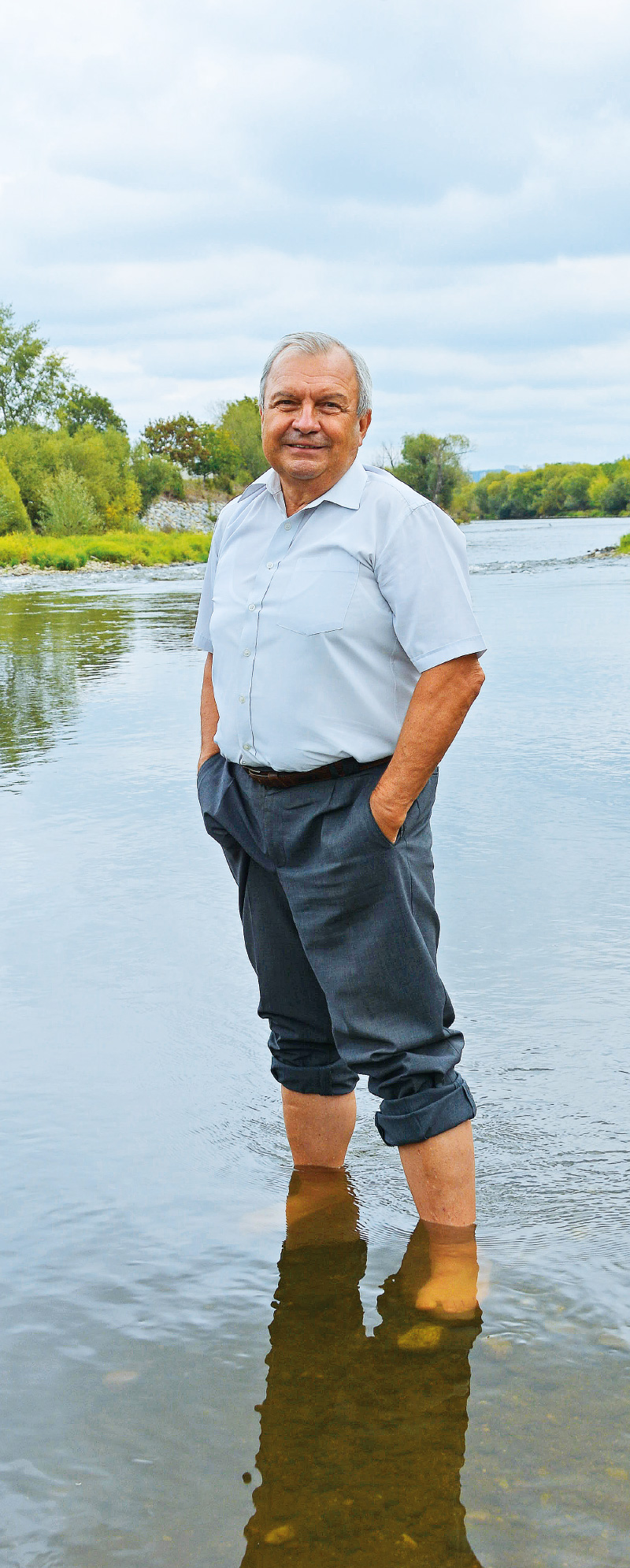
In the Berounka river, approximately 150 metres from the author’s residence (September 2018)
When you went on to Charles University, did you already know that you wanted to work in the area of water?
It began as early as grammar school. I was fascinated by details, for example the “little red spheres” in the water. Later, I came to know that they were water mites. Or caddisfly larvae, which as boys we called “living sticks” – they build their cases from pine needles and small pieces of wood. Watching hydra on the surface of a pond, those were experiences that left a lasting impression. I was fortunate in my teachers as well. Our biology teacher at grammar school, Professor Louda, encouraged my interest. And at university I encountered lots of other people who helped to move me forward.
Who influenced you most at the beginning of your career?
I arrived in Prague at the age of seventeen as part of an “accelerated year” from the eleven-year secondary school and, within my first month, I made my way to the Department of Hydrobiology. I took the assistants somewhat by surprise, because when they asked what I wished to specialise in, I replied without hesitation: the self-purification process. I explained to them that I travelled along the Sázava every day and that the difference between the stretch upstream and downstream of Stvořidla was so striking that I wanted to understand everything that was happening in the river. When they later asked which group of organisms I wished to focus on, I chose water mites, which caused further surprise – at that time there was essentially only one specialist in water mites in the whole of Czechoslovakia, Dr Láska in Brno. Thanks to my teachers, especially Dr Lellák, I succeeded in establishing contact with him, and he then willingly introduced me to the study of water mites at the microscope in the Brno flat of the Láska family.
At the Faculty, I was strongly influenced by Dr Jan Lellák, Vladimír Kořínek (both later professors), and Jarka Horká (later Kořínková, who unfortunately died at a young age). They were true enthusiasts, willing to devote an enormous amount of time to science. Through them, I was also able to join the Hydrobiological Laboratory of the Czechoslovak Academy of Sciences in the Prague district Smíchov, where, from my fourth year onwards, I accompanied the laboratory staff on regular monitoring of water quality in reservoirs. I wrote my diploma thesis on the self-purification of the Botič between Průhonice village and Prague. Dr. Věra Straškrabová was a great help to me, and above all, Associate Professor Hrbáček. They devoted their time to me, provided literature and guidance, and thanks to their support I was able, after completing my studies, to continue seamlessly in the field within their team.
What did the scientific phase give you most – methodology, patience, the ability to question?
Methodology, certainly, but above all patience and diligence. Repetition, minor setbacks – one must not allow oneself to be discouraged. And, of course, to question results means returning to matters repeatedly and verifying them. At that time, statistical methods were becoming more firmly established. I attended courses in order to be able to apply statistical techniques in my work as a hydrobiologist. Later, this enabled me not only to use statistics, but even to explain it to colleagues and to lecture on it at seminars.
You moved into managerial positions relatively early in your career. What was the most difficult aspect?
I would not say that it was early – I had spent more than twenty years engaged in scientific work in basic research. The turning point came at a time when part of the Academy was to be relocated from Prague to České Budějovice. For me, this was both a personal and a family decision. We had our home in Radotín (which is now part of Prague), and my wife worked at the Faculty of Science in the Department of Algology. Leaving Prague was becoming unacceptable for me. It was one of the most difficult decisions of my life: to leave science and attempt to engage in practical, applied research. I applied for the post of Head of the Microbiological Laboratory at the T. G. Masaryk Water Research Institute, and in 1986 I was accepted and took up the position.
When did you first truly acknowledge that it would no longer be “only” about professional work, but primarily about leading people, responsibility and decision-making – and what was the most difficult aspect of that change for you?
After the political and economic changes of 1989, I applied for the position of Director in 1990. I was strongly encouraged to do so by many Institute employees, and in particular by the heads of water management laboratories throughout the Czech Republic, both in the field of water supply and sewerage and within the state-owned River Basin enterprises, who sent a letter of recommendation to the then Ministry of Forestry and Water Management. I felt that I had a genuine chance of succeeding, yet at the same time I was aware that I did not know everything about water management practice. Therefore, several colleagues helped me prior to the selection procedure, to frame the full scope of what water management encompasses, as my focus until then had been primarily scientific.
I particularly value the support and advice of Ing. Václav Zeman, which were invaluable to me not only at that time but also later on.
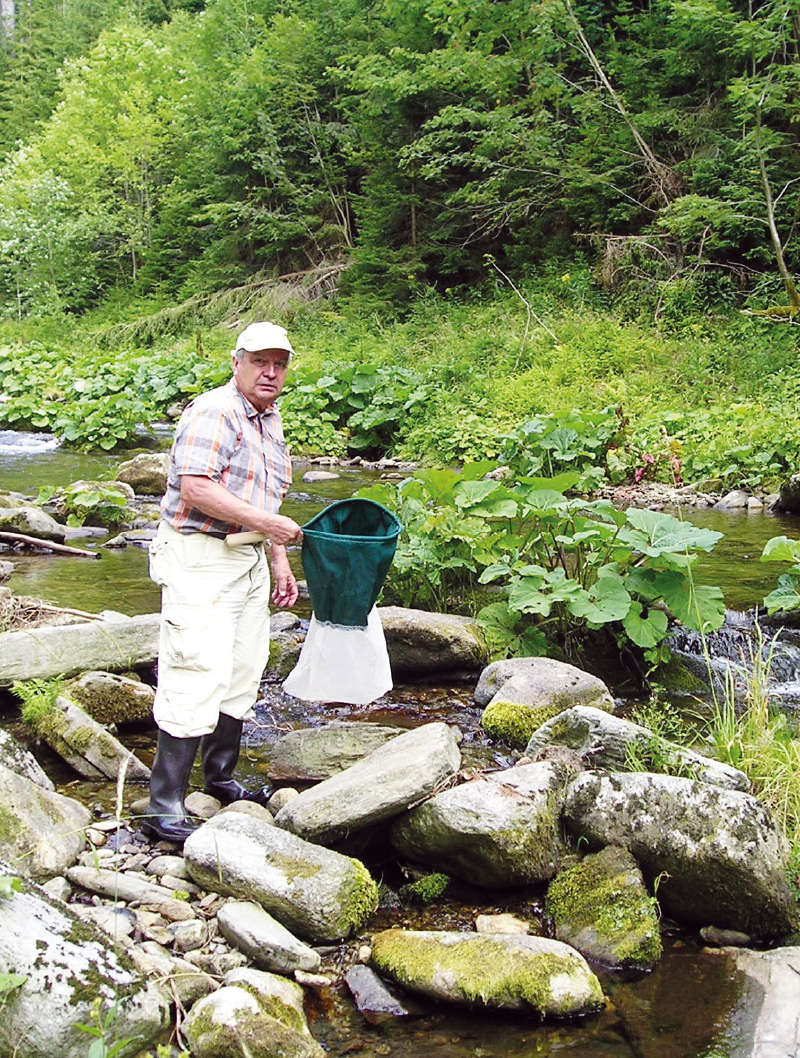
Survey of water mites in Krkonoše National Park, sampling at the Malá Úpa site upstream of its confluence with the Úpa (July 2019)
What was your first day as Director of the Water Research Institute like?
The first day was marked by expectation and also by uncertainty. I had worked there for three years, I knew almost all the employees, and many of them expected that everything would change overnight. However, I immediately sensed the priorities: it was necessary to integrate the Institute, both spatially (having six workplaces at different locations across Prague was untenable) and in terms of working methods, so that teams would be formed to deliver comprehensive solutions rather than everyone pursuing their own agenda. At that time, there were many outstanding experts in individual disciplines and specialisations. The Ministry did not stand in the way of this arrangement, as it was satisfied with obtaining what it required for the governance of water management and left the remainder of the work largely to the discretion of the staff and their research reports. Yet it was precisely for this reason that specialists did not collaborate more closely on specific problems requiring multiple perspectives in order to achieve comprehensive solutions. My three main tasks were therefore as follows: to achieve spatial integration, to achieve professional integration, and to enhance the Institute’s prestige through international cooperation; this was gradually and successfully developed with twelve institutes in six European countries.
However, I was taken aback at my very first meeting at the newly established Ministry of the Environment. I did not comply when I was advised whom I should appoint as my deputy – and the “punishment” came in the form of a reduction in part of the Institute’s funding, which I then had to resolve through savings. At the same time, my superior there was Deputy Minister Benda, who was convinced that institutions of this kind were unnecessary and that the Institute itself was redundant. He intended to fundamentally restructure it and, in essence, almost abolish it altogether.
How did you cope with it?
The outcome was that I said: “No, no – I am convinced that institutions of this kind should be preserved. One need only look west of us, to countries that are economically advanced and democratic.” I therefore took a strategic step and proposed that the matter be assessed by a group of respected foreign experts, preferably from the United Kingdom. With funding from the European Commission, a team of experts from England came to review the Institute, including its branches, and subsequently produced a report recommending that the Ministry should not dissolve the Institute but, on the contrary, develop it and give it the opportunity to generate additional income through practical projects. It was a strategic move that saved the Institute – first at that moment, and later once again.
At the same time, this marked the beginning of a period in which internal integration and the “hard” realities within the Institute also had to be addressed. Not everyone was able to accept that 620 employees was excessive and that not all were being used effectively. Reducing staff numbers was demanding and, on a human level, very unpleasant. I nevertheless tried to proceed in such a way that I would not appear as a ruthless director dismissing people indiscriminately. I studied their outputs, spoke with them, and pointed out concretely that, for example, there had been no discernible progress in their work over a period of three years. It was difficult because at that moment you hold up a mirror and show that, in effect, they had drifted along for three years without producing meaningful results. The reduction in staff numbers was also influenced by the privatisation enthusiasm of the time, when some employees left for the private sector; unfortunately, most of them were of high quality.
You mentioned Britain. How did you further develop one of your priorities, namely international cooperation?
Cooperation with Germany was particularly important because of the Elbe. The International Commission for the Protection of the Elbe River was established, and I wanted the Institute to be involved. One of the most intensive partnerships after 1990 was with GKSS Geesthacht. We carried out joint monitoring and sampling, and from this emerged the tradition of the Magdeburg Seminars, which continues to this day. It began almost humorously: a colleague from GKSS, Dr Wilken, needed to catch a train urgently and was looking for a taxi. I drove him to the main railway station myself, and on the way we agreed that we would turn our cooperation into regular seminars. And it has endured ever since.
We were also assisted by RIZA in the Netherlands. I took a group of senior staff there so that they could see how a comparable institute operates. Technical support from the Danish Hydraulic Institute was also important. At that time, they had developed a highly regarded innovation – the mathematical model MIKE 11. I went to see their director, who had founded the institute, and asked him directly whether the TGM WRI might obtain their widely acclaimed tool for modelling flows, floods and the testing of flood protection measures. After a longer discussion, he said to me: “Very well, I will give you MIKE.” When I asked what they would expect in return, he replied: “Nothing.” I still regard it as an exceptional moment – on my part, perhaps audacity; on his, remarkable generosity.
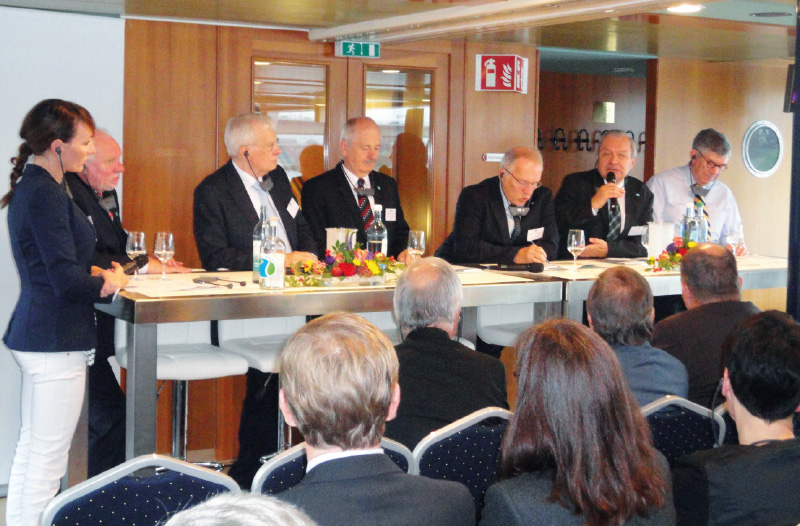
Meeting of the Presidents of the International Commission for the Protection of the Elbe River on the 25th anniversary of its establishment (from left: moderator, Dr H. Wendenburg, Dr Ing. D. Ruchay, Ing. F. Pojer, Dr H. Bloech, Dr P. Punčochář and Dr F. Holzwart)
You moved from the Institute to the Ministry of Agriculture. Did the difference surprise you?
Indeed. It is a different kind of work – preparing documentation for decision-making, dealing with legislation, and navigating internal ministerial processes. Ing. Jan Plechatý was a great help to me; he quickly “trained” me and would occasionally place something on my desk that had to be prepared urgently for the Minister. In that environment, one acquires rapid practical skills. At the same time, I realised that if one wishes to promote substantively sound measures, one must be able to communicate effectively with politicians and senior officials within the state administration. And I did not always comply with the original brief if I was convinced that it was wrong.
Some of the confrontations were hard, and in retrospect I sometimes wonder how I managed to withstand them. It remains somewhat surprising to me that no minister removed me from the post of Director General, because I consistently sought to maintain a professional standpoint – to explain what was appropriate and important for water management and the administration of water resources, and, conversely, to reject initiatives that would have been detrimental to them.
You once described the drafting of the new Water Act as a milestone in your career.
It was an entirely new Act, as the one dating from the 1970s had truly become obsolete. The task had originally been assigned to the Ministry of the Environment, but as it was unable to bring it to completion, it was ultimately entrusted to the Ministry of Agriculture. We began working intensively on it at the turn of 1999 and 2000.
Here I must highlight my colleague, Ing. Mirek Král, who moved with me from the TGM WRI to the Ministry. Mr Král was a veritable repository of knowledge in administrative procedures and water management development. Together with other colleagues and legal experts from the state-owned River Basin enterprises, we gradually drafted the individual sections of the Act.
If you were to describe the greatest difference between drafting a sound legislative proposal and getting it implemented in practice, what would it be?
To be able to advance a well-formulated technical text politically. In this regard, I must mention the absolutely invaluable role of Ing. Karel Tureček, the then Deputy Minister of Agriculture. He essentially trained me not to be discouraged by the cries of politicians in the Chamber of Deputies and the Senate, but to persuade them gradually, through factual argument, that this is how it should be done, and it is the right approach.
At the same time, we were engaged in a fairly hard-fought struggle with the Ministry of the Environment, which was trying to modify a number of provisions according to its own ideas, while we resisted this and sought to ensure that the measures were technically feasible in practice and that they would genuinely work for the benefit of water in the Czech Republic.
I also remember some particularly tense moments: I attended meetings of the ministers, and I will never forget a very heated exchange of views between myself and the Minister of the Environment, Miloš Kužvart, when I was admonished that I was speaking to a minister and should stop. Fortunately, we had known each other for some time, and he then said: “no, we know each other and we have to talk this through”, which I appreciated. In the end, the Act was passed; the main competences remained with the Ministry of Agriculture, and the competences of the other ministries were clearly defined in the Act as so-called shared competences of the central water authorities.
Apart from the construction of new reservoirs, which three measures do you think have moved water management forward?
If we are speaking about frameworks and principles, I consider the following to be important: the principle that the polluter pays and the user pays, the protection zones of water sources and their enforcement, and technical safety supervision – its importance is now increasing even for smaller reservoirs and fishponds because of the risks posed by torrential rainfall and the damage it can cause. A major advance has also been the development of information systems and modelling tools.
Today, many things are predictable and can be traced in databases. As for reservoirs, it has been and remains crucial to maintain territorial protection of sites where, in the future, water storage could be addressed through sufficiently large reservoir dams. A disappointment for me is how long it takes for some projects to be implemented; for example, Nové Heřminovy flood-control reservoir. Unfortunately, it often works in such a way that things only start to move after major events accompanied by damage and adverse consequences that wake both politicians and the public to the need for decisions.
If you were to look into the future, how do you see water management in fifteen to twenty years?
We will have to pay much greater attention to the consequences of rising air temperatures and the effect of evapotranspiration on water resources. And we will have to prioritise the accumulation of surface water, despite resistance from part of the public. Groundwater is not being replenished sufficiently because of the lack of snow and rapid runoff after intense rainfall. We have not yet succeeded in initiating measures to strengthen groundwater storage through infiltration-based approaches. Without water, none of this will work: quality of life, the economy, sustainability, the energy industry.
The public should stop listening to and believing simple claims that a change in land management alone will solve everything. Yes, it is important, but there are situations where even with good land management, a flood will occur because the soil profile is already saturated, or drought will arise due to prolonged high temperatures and the consumption of water by vegetation. I see the future in the need to convince the public that certain technical measures, such as water management structures, are necessary, even if they have local impacts on municipalities or on nature. Weather conditions often contribute to this as well, for example through abrupt changes that can negatively affect local residents. Nevertheless, the present abundance of water generally leads the public to forget very quickly.
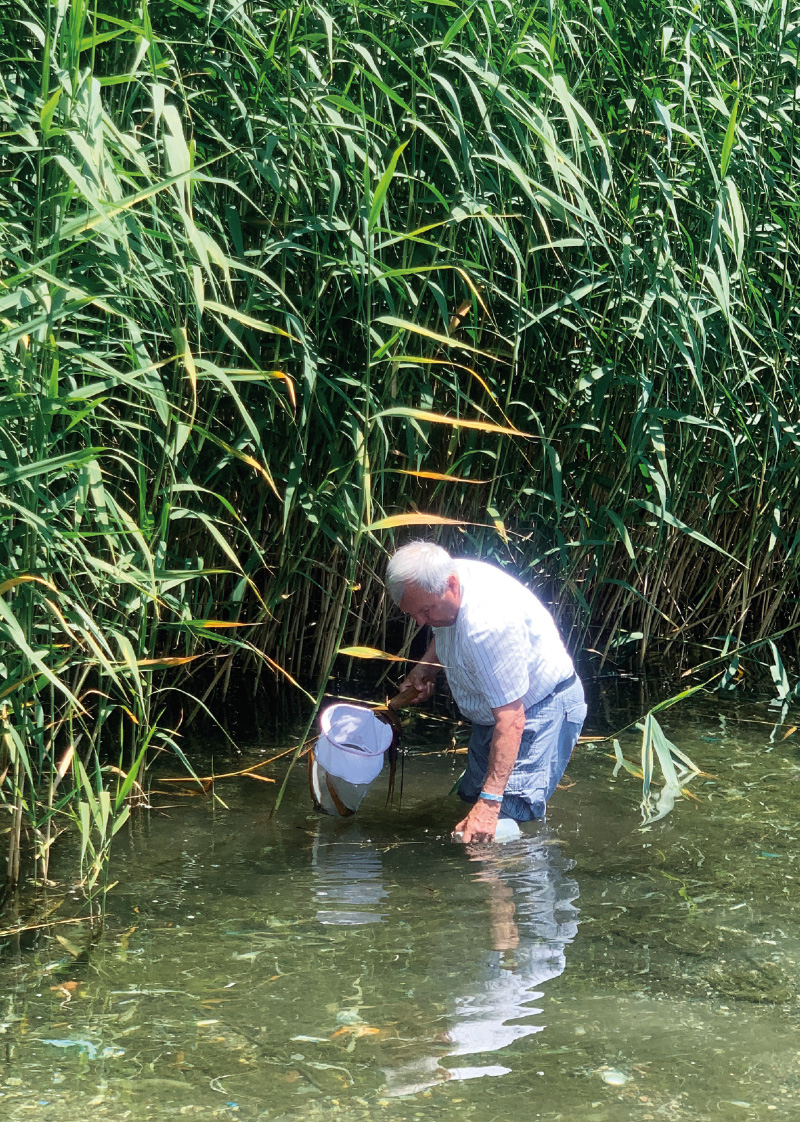
Sampling of water mites in Lake Ohrid in Albania (July 2023)
If you were standing in front of first-year water management students, what would you say to them?
“You are in the right place, because life on Earth without water is not possible.” I would recommend that they read the European Water Charter of 1968. And I would also tell them that water is a most faithful companion “most faithful mistress” – it gives great satisfaction when you succeed in improving it or increasing its reserves. However, it requires diligence, perseverance, and interdisciplinary knowledge. And do not rely blindly on modern information technologies: if a blackout occurs and everything fails, it will be you who must make decisions and manage with what you know.
What does your ideal day outside work look like?
When the time off lasts longer than three or four days, I become uneasy that I am neglecting something. An ideal day: I get up, make coffee, and go through the news on water management and the status of rivers. I follow this reporting every day and have it on my mobile phone as well. Then I would go fishing, perhaps to the Berounka or the beloved Sázava. To sit and gaze, recall memories, and do a little fishing. And if it were a longer break, I would go into the field: I would like to add to my collections and surveys of water mites in Šumava Mountains. In my home laboratory, the collected samples will wait. I think ahead: when one day I am no longer able to go out into the field, I want to have the material and devote myself to it in peace.
If I may, a few quick points to conclude:
For me, water represents: the natural source that has captivated me.
The greatest professional lesson: leaving research work and not going to České Budějovice to pursue a career in science.
The most difficult decision in my career: probably the same as the greatest professional lesson, because I moved from basic research to applied research and subsequently into public administration.
One thing I wish the public understood about water: that without water it is not possible to live, and that water resources must be safeguarded through water management and technical measures, not only by expecting nature-based measures to ensure them.
If I had not devoted myself to water, I would have been: perhaps a physician – that would also have attracted me a great deal. Paradoxically, my family tried to dissuade me from it; when I was living in the student hostel with medical students, I thought to myself: “Anthropology seems really easy, I would certainly enjoy that!”
Mr Punčochář, thank you for the interview.
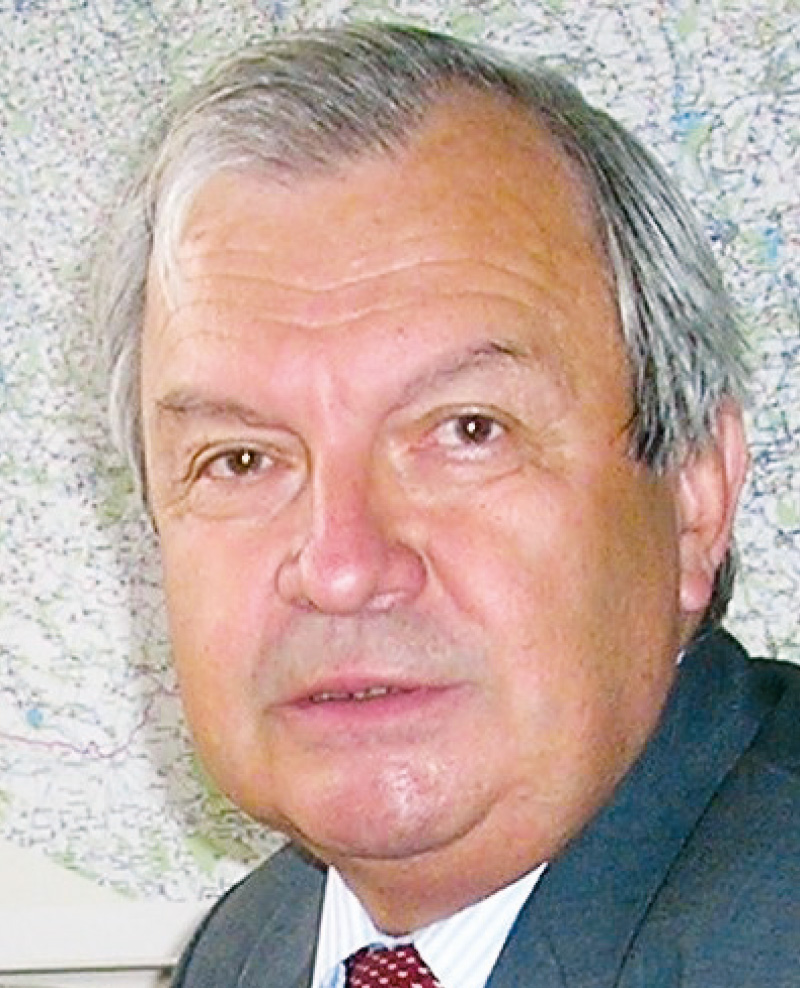
RNDr. Pavel Punčochář, CSc.
RNDr. Pavel Punčochář, CSc., was born on 20 March 1944 in Pelhřimov. He graduated from the Faculty of Science of Charles University in Prague, where he was awarded the degree of RNDr. in 1969, and subsequently obtained the degree of CSc. at the Czechoslovak Academy of Sciences (CAS). He specialised in hydrobiology and water microbiology at the Hydrobiological Laboratory of the CAS (1965–1984), at the Institute of Landscape Ecology (1985–1986), and, from 1986 onwards, at the Water Research Institute, where he was appointed Director (1990–1997). Since 1998 he has been employed at the Ministry of Agriculture, initially as Director of the Department of Water Policy and subsequently as Director General of the Water Management Section. He is also a member of the Senate’s Standing Commission WATER–DROUGHT
and, for fourteen years, served as the “Water Director of the Czech Republic” in negotiations with the European Commission. He has published more than 350 professional papers in the Czech Republic and abroad. He lectures at the Czech University of Life Sciences Prague and also teaches at the Faculty of Fisheries and Protection of Waters of the University of South Bohemia in České Budějovice. His personal interests include angling and research on water mites.
