

ABSTRACT
Household detergents are an important source of complex mixtures of anthropogenic substances entering municipal wastewater systems and, subsequently, receiving waters. This study presents a comparative assessment of the acute ecotoxicity of conventional detergents and their environmentally certified counterparts (EU Ecolabel) using a battery of bioassays representing different trophic levels. The tests included the luminescent bacterium Vibrio fischeri, the water flea Daphnia magna, the green alga Desmodesmus subspicatus, and seeds of white mustard Sinapis alba.
The determined EC50 values and inhibition levels at a concentration of 100 mg/L revealed substantial variability in the toxic effects of the final formulations, which often did not correlate with the “eco” marketing label. The most notable finding was the high acute toxicity of an environmentally certified laundry gel to algae (72h EC50 3.93 mg/L) and water flea (48h EC50 5.49 mg/L), exceeding the toxicity of the conventional product by an order of magnitude. This effect can likely be explained by the high total surfactant content in the environmentally certified product (up to 50 %) and potential synergistic interactions with additional additives such as enzymes. In contrast, within the shampoo category, the eco-variant (EC50 > 100 mg/L) showed lower toxicity due to the replacement of aggressive sulphate surfactants with non-ionic surfactants based on coco-glucoside.
From a methodological perspective, the study confirmed that Daphnia magna and Desmodesmus subspicatus are the most sensitive bioindicators of detergent exposure, while Sinapis alba seeds exhibited considerably higher tolerance to acute exposure. The results highlight the importance of experimental testing of complete product formulations, as the regulatory criteria of the EU Ecolabel, primarily focused on biodegradability, do not necessarily guarantee lower acute toxicity of the mixture. Due to their widespread and continuous use, detergents may behave as pseudo-persistent pollutants in aquatic environments, maintaining a relatively constant toxic pressure on aquatic biota despite the theoretical biodegradability of their individual components.
INTRODUCTION
The use of household detergents represents a continuous source of anthropogenic chemical substances entering municipal wastewater systems and subsequently aquatic receiving environments [1, 2]. These products, including, for example, hand dishwashing detergents, laundry gels, dishwasher tablets, and shampoos, are defined as complex mixtures of intentionally added substances, by-products, and impurities [3, 4]. The dominant components of these formulations are surfactants, which account for approximately 15–40 % of the total mass of the detergent [2, 5]. In addition to surfactants, detergents contain a range of other additives, such as bleaching agents, enzymes, preservatives, and fragrances, which may exhibit their own toxic effects [6, 7].
Although modern wastewater treatment plants (WWTPs) remove common surfactants with high efficiency, often exceeding 90 %, some of these substances and their metabolites may still enter aquatic receiving environments [5, 8, 9]. As a result of the widespread and continuous use of detergents, these substances behave as so-called pseudo-persistent pollutants in the hydrosphere. Although the individual components are biodegradable, their concentrations in the environment remain relatively stable due to the continuous input from municipal wastewater. This phenomenon represents a long-term toxic pressure on aquatic organisms [9]. Exposure to detergents may induce adverse biological responses, particularly through disruption of cell membrane integrity and interference with the metabolic processes of organisms [5, 6, 8, 10].
The environmental risks associated with conventional detergents may be further increased by certain additives. These include, for example, phosphates and phosphonates contributing to the eutrophication of aquatic ecosystems [2, 7], persistent chelating agents such as EDTA, and preservatives belonging to the isothiazolinone group. Other potentially problematic components include enzymes such as subtilisin, which may exhibit high acute toxicity to aquatic organisms [3, 11–14].
In response to the environmental impacts of detergents, the EU Ecolabel certification scheme was introduced in the European Union (Regulation (EC) No 66/2010) [15]. The criteria of this certification are based on scientific principles and focus primarily on the biodegradability of components (both aerobic and anaerobic) and on reducing the overall toxic burden on the aquatic environment through the calculation of the Critical Dilution Volume (CDV). The criteria also include restrictions on or bans of substances of very high concern (SVHCs) and substances with high persistence or bioaccumulative potential.
Despite these regulatory requirements, which primarily focus on the environmental fate of individual components, the marketing label “ECO” may not always directly correlate with low acute toxicity of the final formulation across all trophic levels [5]. Within the EU Ecolabel criteria, substances classified as highly toxic to the aquatic environment are permitted, provided that they comply with the established limits and requirements regarding performance and biodegradability. Moreover, in the complex matrix of the final product, synergistic interactions between surfactants and other additives may occur, potentially modifying the resulting toxic effect beyond the level predicted from the properties of the individual components [5, 16, 17].
To objectively assess the actual impact of detergents on biota, a battery of bioassays representing different trophic levels of aquatic and terrestrial ecosystems was used in this study. The test battery included the luminescent bacterium Vibrio fischeri, which represents a standard indicator of microbial toxicity sensitive to a broad spectrum of pollutants. In addition, bacteria fulfil an important role as decomposers of organic matter in aquatic ecosystems. Another test organism used was the green alga Desmodesmus subspicatus, a unicellular primary producer sensitive to the lytic effects of detergents and simultaneously susceptible to growth stimulation in the presence of nutrients. Due to their position at the base of the food chain, algae represent a key trophic level in aquatic ecosystems. To assess toxicity at the consumer level, water fleas (Daphnia magna) were used, as they are among the most sensitive model organisms for surfactant testing. These planktonic crustaceans constitute an important component of zooplankton and form a significant link in the food chain of freshwater ecosystems. The test battery was complemented by a phytotoxicity test using seeds of white mustard (Sinapis alba), which serves as a model indicator of potential risks to terrestrial organisms, for example in the agricultural use of wastewater or sewage sludge.
The aim of the study was to verify to what extent the marketing declaration of environmental friendliness corresponds to the actual impact on aquatic biota. The study tests the hypothesis that certified detergents exhibit lower acute hazard than conventional products, taking into account the synergistic effects of all components present in the tested mixtures.
MATERIALS AND METHODS
Tested substances and sample preparation
Eight commercially available household detergents were tested in the study across four categories (hand dishwashing detergents, laundry gels, dishwasher tablets, and shampoos), each represented by a conventional and an environmentally certified variant. The characteristics of the samples, including pH and composition, are presented in Tab. 1. Stock solutions at a concentration of 1 g/L were prepared by dissolving an accurately weighed amount of the product in demineralised water and subsequently diluted to the required concentration. For the final tests, a logarithmic concentration series starting at 100 mg/L was used. In this study, this value was established as the upper testing limit, as products with EC50 values exceeding this threshold are no longer classified as acutely toxic to the aquatic environment according to the Globally Harmonized System (GHS) and the European CLP Regulation. Moreover, testing at higher concentrations lacks environmental relevance, since typical concentrations of surfactants (i.e. the active substances contained in detergents) in municipal wastewater generally reach only 1–10 mg/L and, after passing through WWTPs with high removal efficiency, are further substantially diluted in receiving waters [8, 18, 19].
Tab. 1. Characteristics of tested detergents and their declared composition
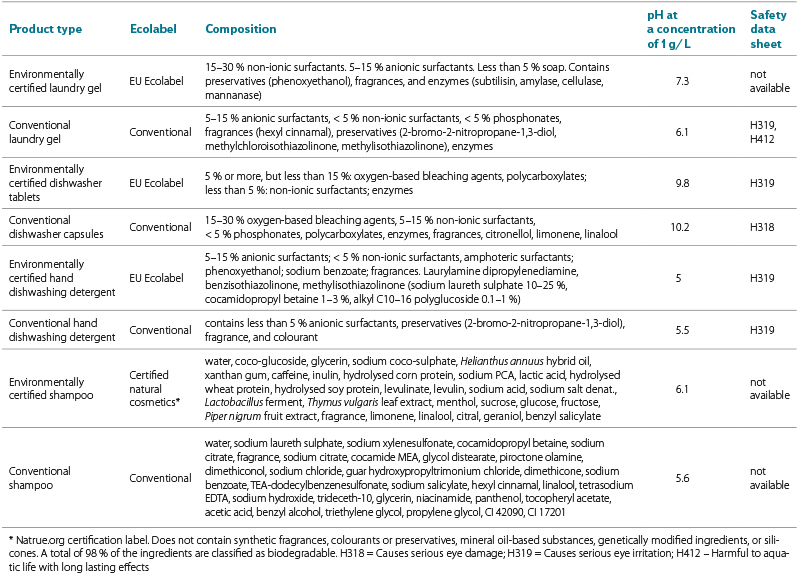
The pH of the working solutions was adjusted as necessary using 0.1 M NaOH and HCl to a value of 7.5 ± 0.5 in accordance with the validity criteria of standardised test protocols. This step eliminated the influence of extreme acidity or alkalinity of the products, which could otherwise induce a non-specific toxic response independent of the effects of the substances present.
The bioassays were conducted in an accredited laboratory with an implemented quality control system, including regular determination of the toxicity of a reference substance (potassium dichromate) to verify the condition of the test organisms. The results of the reference tests confirmed that the sensitivity of the cultures used complied with the requirements of the relevant standards.
Luminescence inhibition test using Vibrio fischeri
Acute toxicity to marine luminescent bacteria was determined according to ISO 11348-2 using the strain Vibrio fischeri [20]. The test was performed using the LumiStox 300 measuring system (Dr Lange), comprising an incubation unit and a luminometer. The osmotic pressure of the samples was adjusted by the addition of NaCl to a final concentration of 2 %. Exposure was carried out at a stable temperature of 15 ± 0.2 °C and pH 7.0 for 15 and 30 minutes. The target parameter was the EC50 value, representing the concentration causing a 50% reduction in bacterial luminescence intensity compared with the control, calculated from six concentration points within the range of 1–200 mg/L.
Acute toxicity test using Daphnia magna
Determination of acute immobilisation of the freshwater crustacean Daphnia magna (Straus) was carried out in accordance with ČSN EN ISO 6341 [21]. A total of 20 individuals younger than 24 hours were used for testing. The tests were conducted under static conditions for 48 hours in vessels containing 50 mL of test solution without feeding or aeration. The temperature was maintained within the range of 18–20 °C under a photoperiod of 16 hours of light and 8 hours of darkness. The target parameters were the EC50 values after 24 h and 48 h, defined as the concentration of the product causing immobilisation in 50 % of exposed individuals. Five to six concentration levels ranging from 0.1 to 100 mg/L were used for the determination.
Growth inhibition test using Desmodesmus subspicatus
To evaluate effects on primary producers, a growth inhibition test using the freshwater alga Desmodesmus subspicatus was performed according to ČSN EN ISO 8692 [22]. Exposure was carried out in Erlenmeyer flasks with an initial density of 10,000 cells/mL in ISO culture medium for 72 hours. Cultivation was conducted at a temperature of 23 ± 1 °C under continuous illumination with an intensity of 9,000 ± 1,000 lux and constant stirring. The density of algal cells was measured after 72 hours using a counting chamber. The resulting parameter was the EC50 value, expressing 50% inhibition of the specific growth rate of the algal culture, calculated from five concentration levels within the range of 1–100 mg/L.
Phytotoxicity test using Sinapis alba seeds
The test using white mustard seeds was performed according to the Methodological Guideline of the Waste Department for the Determination of Waste Ecotoxicity [23]. Seeds (30 per concentration per Petri dish) were placed in duplicate on filter paper in Petri dishes and moistened with 5 mL of the tested solution at the required concentration. Incubation was carried out in a thermostat without access to light for 72 ± 2 hours at a temperature of 20 ± 2 °C. The monitored test parameter was the average root length of white mustard seedlings after 72 hours, from which growth inhibition was calculated.
Calculation of surfactant concentration in the samples
As the product compositions are reported in percentage ranges, the maximum theoretical surfactant load (i.e. a worst-case scenario) was calculated for the purposes of the discussion; however, this calculation represents only a theoretical estimate based on the declarations provided on the product packaging rather than an analytically determined value (Tab. 1).
The following equation was used to calculate the surfactant concentration in the tested sample (Csurfactant):

Statistical data analysis
The tests were performed in three independent replicates. Statistical analysis included the calculation of mean values and standard deviations. EC50 values were calculated using GraphPad Prism (GraphPad Software) by means of a four-parameter logistic curve based on nonlinear regression. The statistical significance of differences between the mean inhibition values of the tested solutions and the negative control was assessed at a significance level of α = 0.05 (p < 0.05) using Student’s t-test.
RESULTS
Validity of bioassays and overall ecotoxicological profile
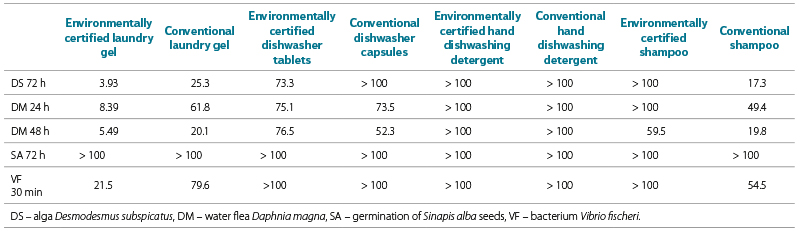
The results of the EC50 determinations (Tab. 2) and inhibition at the limit concentration of 100 mg/L (Tab. 3) indicate that the sensitivity of the tested organisms to detergent exposure decreased in the following order: the water flea Daphnia magna > the alga Desmodesmus subspicatus > the bacterium Vibrio fischeri > white mustard Sinapis alba.
Within the applied battery of bioassays, white mustard (Sinapis alba) seeds exhibited the highest degree of tolerance to the tested products. In none of the eight evaluated samples was 50% root growth inhibition reached within the tested concentration range, and all EC50 values are therefore reported as > 100 mg/L. According to the GHS and CLP classification standards, the tested products therefore do not meet the criteria for classification as acutely hazardous to this indicator from the perspective of phytotoxicity.
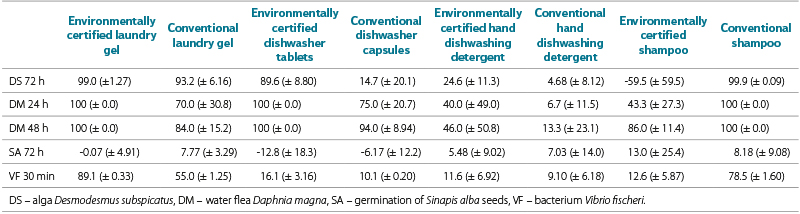
At the highest tested concentration of 100 mg/L, a very low mean response was recorded, not exceeding 13 %. Statistical evaluation using Student’s t-test demonstrated that the measured values did not differ significantly from the negative control (p > 0.05). This lack of statistical significance was primarily due to the higher variability of the measured data, as the standard deviation (SD) values frequently exceeded the mean inhibitory effect.
In half of the tested samples, negative inhibition, i.e. slight stimulation of root growth, was recorded at a concentration of 100 mg/L. The most pronounced stimulatory effect was observed for environmentally certified dishwasher tablets (−12.8 ± 18.3 %) and conventional dishwasher capsules (−6.17 ± 12.2 %). This response is probably related to the nutrient effect of certain components (e.g. phosphonates or plant proteins) at low concentrations, which, in more resistant organisms such as S. alba, obscures the difference compared with growth in the control medium.
The observed high tolerance and absence of adverse effects on the initial developmental stages are fully consistent with studies confirming that detergents at common concentrations do not affect seed germination [7, 24, 25]. A study by Uzma et al. (2018) on maize demonstrated that detergents in the range of 1–500 mg/L had no significant effect on germination. Similarly, Khan et al. reported that surfactant concentrations up to 100 mg/L did not affect the germination of lettuce or garden cress. According to the scientific literature, this resistance is attributed to the barrier function of the seed coat, which effectively protects the plant embryo from the penetration of toxic substances from the external environment [25].
Tab. 2. Results of acute ecotoxicity tests expressed as EC50 [mg/L] for selected bioindicators
Tab. 3. Results of acute ecotoxicity tests expressed as inhibitory effect [%] at a concentration of 100 mg/L (mean ± SD)
Comparative evaluation of products
Laundry gels
The category of laundry gels yielded the most surprising results, with the environmentally certified product (environmentally certified laundry gel) exhibiting significantly higher toxicity than the conventional variant (conventional laundry gel). The environmentally certified laundry gel was classified as highly toxic to both algae (72h EC50 3.93 mg/L) and water fleas (48h EC50 5.49 mg/L), representing approximately a fourfold higher toxic pressure compared with the conventional gel, whose EC50 values ranged from 20.1 to 25.3 mg/L. At the limit concentration of 100 mg/L, the environmentally certified laundry gel caused complete immobilisation of water fleas (100 %) as well as inhibition of algal growth (99 %), which, together with the low EC50 values, demonstrates the high degree of acute hazard posed by this environmentally certified product.
Shampoos
In the shampoo category, the trend was reversed and confirmed the environmental friendliness of the certified cosmetic product. The environmentally certified shampoo exhibited low acute toxicity, with EC50 values above 100 mg/L for most organisms (except for water fleas, 48h EC50 59.5 mg/L), whereas the conventional shampoo was toxic to both algae (EC50 17.3 mg/L) and water fleas (48h EC50 19.8 mg/L).
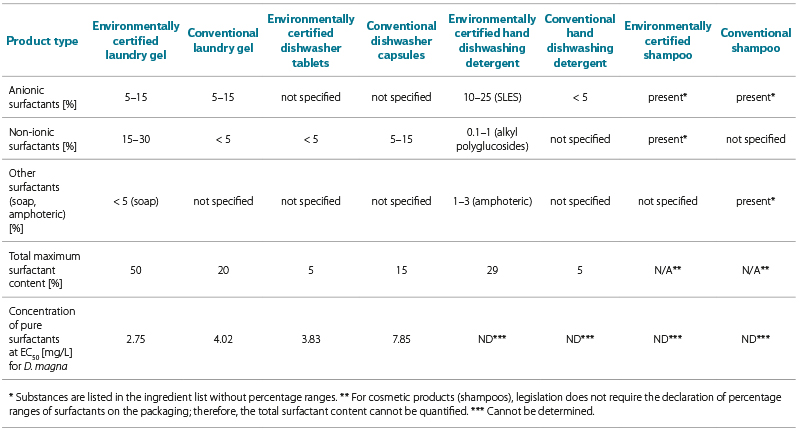
For the environmentally certified shampoo, growth stimulation of algae (-59.5 %) was observed at a concentration of 100 mg/L, indicating a nutrient effect of the contained plant extracts and proteins (e.g. hydrolysed corn, wheat, and soy proteins). In contrast, the conventional variant contained sodium laureth sulphate (SLES), which contributes to the high inhibition of biota. The literature reports EC50 values of SLES for Daphnia magna in the range of 2–20 mg/L [26, 27]. The SLES content in the shampoo is unknown, as the legislation does not require the declaration of percentage ranges of surfactants on product packaging and no safety data sheet is available for this type of product (Tab. 1, Tab. 4).
Tab. 4. Calculation of theoretical maximum surfactant content in products and normalization of toxicity (EC50) to active ingredient for D. magna
Dishwasher detergents
Products intended for dishwashers exhibited a moderate degree of toxicity within the applied battery of bioassays, while significant differences in the sensitivity of individual organisms were identified. The most sensitive indicator for this category was the water flea Daphnia magna, for which the 48h EC50 values ranged from 52.3 mg/L (conventional dishwasher capsules) to 76.5 mg/L (environmentally certified dishwasher tablets). At the limit concentration of 100 mg/L, both products caused almost complete immobilisation of water fleas (94 % for conventional capsules and 100 % for environmentally certified tablets), indicating a high risk to aquatic invertebrates in the event of local overloading of the receiving environment.
A pronounced difference was observed in the effects on the alga Desmodesmus subspicatus. While the conventional capsules exhibited only mild inhibition at 100 mg/L (14.7 %), the environmentally certified variant caused strong growth suppression (89.6 %), corresponding to the measured EC50 value of 73.3 mg/L. This paradox is noteworthy, as the conventional product theoretically contains a higher load of surfactants (15 %) as well as bleaching agents (15–30 %) than the environmentally certified tablets (5 % surfactants and 5–15 % bleaching agents). The toxicity of the environmentally certified variant is probably influenced by other specific additives acting as stress factors for algae.
For the bacterium Vibrio fischeri, acute toxicity was negligible in both samples, with inhibition below 16 % at a concentration of 100 mg/L; consequently, the EC50 values were > 100 mg/L.
Hand dishwashing detergents
Hand dishwashing detergents were identified as the most environmentally benign category within the entire study. For all tested trophic levels, the determined EC50 values were consistently higher than 100 mg/L, which classifies these products, according to the criteria of the CLP Regulation, as substances with/lout acute hazard to the aquatic environment.
At the highest tested concentration of 100 mg/L, only low levels of inhibition were recorded: the conventional detergent caused only 13.3 % inhibition in water fleas, whereas the environmentally certified variant caused 46 % inhibition. The stronger effect of the environmentally certified detergent may be attributed to the higher declared content of the anionic surfactant SLES (up to 25 %) compared with the conventional sample (< 5 %).
The results obtained for bacteria and algae showed that inhibition ranged from 4.6 to 24.6 % for both product types, with the lowest response recorded for the bacterium Vibrio fischeri (9.1–11.6 %).
Statistical evaluation using Student’s t-test confirmed that, for most organisms (with the exception of water fleas exposed to the environmentally certified variant), the measured effect at a concentration of 100 mg/L did not differ significantly from the negative control (p > 0.05). The results confirm that, despite the presence of substances such as SLES or preservatives (isothiazolinones), the final toxicity of these mixtures is very low owing to dilution in the working solutions.
DISCUSSION
The results of this study demonstrated pronounced differences in acute toxicity among the individual detergent categories, with the most marked effect observed for laundry gels. The environmentally certified laundry gel exhibited an order of magnitude higher toxicity towards the tested aquatic organisms than its conventional counterpart. However, the main factor underlying this increased toxicity was probably not the “ECO” nature of the formulation itself, but rather the high overall surfactant content, which in the environmentally certified variant reached a theoretical maximum of up to 50 %, compared with approximately 20 % in the conventional product (Tab. 4).
After recalculation of the EC50 values to the concentration of pure surfactants, the toxic profiles of both products became considerably more similar. For Daphnia magna, the surfactant concentration at the EC50 level reached approximately 2.75 mg/L for the environmentally certified gel and 4.02 mg/L for the conventional variant. This result suggests that surfactants represent the dominant factor determining the acute toxicity of the mixture in both types of formulation. At the same time, this finding confirms that even substances with relatively favourable biodegradability may exert significant toxic pressure on aquatic organisms when present at high concentrations in the final product. Moreover, the measured EC50 values approached environmentally relevant surfactant concentrations, which at WWTP effluents generally remain below 1 mg/L [8, 18, 31], although concentrations of anionic surfactants exceeding 8 mg/L have also been reported [18]. According to the literature, chronic toxic effects on aquatic biota may occur at surfactant concentrations as low as approximately 0.1 mg/L, indicating a realistic risk of both acute and chronic toxic effects even under conditions of moderate local overloading of the receiving environment.
Nevertheless, the results of toxicity normalisation to pure surfactant concentrations must be interpreted with awareness of the considerable uncertainty arising from the manufacturers’ practice of declaring composition only within broad percentage ranges. The applied estimate (worst-case scenario), based on the maximum possible concentration, may lead to theoretical overestimation of the surfactant load. This lack of transparency regarding the composition of commercial mixtures, combined with the inability to quantify surfactant content in shampoos, confirms that, for water management practice, direct testing of final formulations as a whole represents a more valid approach, as it is the only method capable of capturing synergistic interactions among all additives.
The slightly higher toxicity of the environmentally certified gel, even after recalculation to surfactant content, can probably be attributed to the synergistic effects of additional additives, particularly enzymes. For example, the proteolytic enzyme subtilisin is classified as a substance highly toxic to aquatic organisms (H400), and the literature reports its ability to damage cellular structures even at relatively low concentrations [6]. These results support the assumption that the resulting toxicity of detergent formulations is determined not only by surfactant concentration, but also by complex interactions among the individual components of the mixture.
The necessity of testing final products as complete formulations, rather than only their isolated components, is further confirmed by the paradox observed in dishwasher detergents. In this case, the environmentally certified variant caused strong inhibition of algae (89.6 %), whereas the conventional capsules induced only mild inhibition (14.7 %), despite the fact that the conventional product contained a threefold higher surfactant load (15 % vs. 5 %). This demonstrates that synergistic interactions occur within complex mixtures and may amplify the resulting toxic effect beyond the level predicted from the properties of the individual components.
In the context of discussions on the environmental impacts of detergents, interpretation of the “ECO” label plays a crucial role, as consumers perceive it as a promise of lower toxicity and high biodegradability [5, 27]. Market surveys indicate that more than 50 % of customers are willing to pay extra for such products. Nevertheless, the literature expresses justified scepticism towards marketing claims not supported by independent certification, as the proprietary composition of products often prevents public scrutiny of all contained substances [5].
Despite the stringent regulatory requirements for the award of the EU Ecolabel, which primarily focus on the biodegradability and environmental fate of individual components, the results of this study confirm that environmental certification does not necessarily represent an absolute guarantee of lower acute toxicity of the final formulation across all trophic levels. This finding is fully consistent with the conclusions of Gray (2022), who also documented cases in which “ECO” products were more toxic to aquatic invertebrates than their conventional alternatives [5]. Similar conclusions were reported by Igos (2014), who stated that dishwasher tablets bearing an ecolabel did not exhibit a significant advantage over standard phosphate-free products, with their ecotoxic potential being nearly identical [28].
These findings underline the necessity of testing complete mixtures, as synergistic interactions among permitted additives (e.g. enzymes, fragrances, or preservatives) may modify the resulting toxicity beyond the level predicted from the individual components [6, 16].
The present study primarily focused on the acute ecotoxicity of final formulations, which represents an essential first step in the assessment of environmental risks, although with certain methodological limitations. The main limitation lies in the absence of data on chronic toxicity, which is particularly important for detergents as pseudo-persistent pollutants; long-term exposure to sublethal concentrations in receiving environments may affect the reproduction, growth, and physiological functions of biota in ways that short-term tests are unable to capture [9, 29]. Furthermore, the study did not address the assessment of genotoxicity and mutagenicity, although the scientific literature confirms that complex mixtures of surfactants and specific additives may induce DNA damage or increase micronucleus frequency even at concentrations that do not cause immediate mortality [6, 16, 30]. Additional limiting factors include the insufficiently explored potential for endocrine disruption [31, 32] and the absence of monitoring of the toxicity of biodegradation intermediates, which in some cases may exhibit greater hazard than the parent substances [11, 16]. It should also be noted that only a limited number of products within each category were tested, which may to some extent restrict the generalisability of the obtained results; the observed differences therefore cannot be unequivocally interpreted as a universally applicable trend. Expansion of the test battery to include the above-mentioned aspects will be the subject of a follow-up study, enabling a more comprehensive understanding of the long-term environmental impacts of modern detergents.
CONCLUSION
The results of this study indicate that, for water management practice and environmental risk assessment, it is essential to test final products as complete formulations rather than relying solely on theoretical calculations (e.g. Critical Dilution Volume – CDV) or marketing labels [16]. Experimental data confirm that the “ECO” label cannot automatically be equated with low acute toxicity, which is consistent with the findings of previous studies that also documented cases of higher toxicity of “green” products to aquatic organisms [5]. Although the EU Ecolabel certification guarantees improved biodegradability and restrictions on persistent substances, this benefit does not necessarily imply lower risk to biota in the event of accidental discharge of undiluted products into receiving waters. The main factor influencing toxicity remains the presence of highly concentrated formulations, in which the intrinsic hazard of the mixture is determined by the extreme surfactant load (up to 50 %) and the presence of specific additives that, through synergistic interactions, may damage cell membranes even at low concentrations. The study therefore underlines the critical necessity of using a battery of bioassays to validate manufacturers’ environmental claims within regulatory processes, as only direct testing of complex mixtures can capture the actual toxic pressure exerted on aquatic ecosystems [16].
Acknowledgements
This article was prepared within the framework of the long-term research activities of TGM WRI, supported by institutional funding from the Ministry of the Environment of the Czech Republic for the long-term conceptual development of the research organisation.
The Czech version of this article was peer-reviewed, the English version was translated from the Czech original by Environmental Translation Ltd.
